
14Products




Digital and Smart Positioners for Control Valves — Precision, Diagnostics, and Industrial Connectivity
In any process control loop—flow, pressure, level, or temperature regulation—the control valve is the final actuator: the device that translates the controller's signal into physical action on the fluid. The quality of this translation directly determines the loop's stability, process precision, and system energy consumption. The digital positioner is the device that ensures the actual valve position always matches the controller's setpoint, correcting in real-time disturbances caused by stem friction, differential pressure variations, seat wear, and temperature changes.
Unlike conventional analog electropneumatic positioners—which only execute the signal without feeding information back to the control system—the digital positioner incorporates a microprocessor, non-contact position sensor, and digital communication protocol that enable auto-configuration, auto-tuning of the internal PID loop, continuous diagnosis of valve and actuator status, and bidirectional communication with the control system for predictive maintenance. At Cematic, we offer a complete range of digital positioners for linear and rotary valves, with HART and Profibus-PA communication, in standard and ATEX versions.
What is a digital positioner and how does it work?
The digital positioner operates following a continuous high-frequency control cycle:
- Setpoint Reception: The DCS or PLC's PID controller sends a 4–20 mA current signal representing the desired valve position (4 mA = 0% = closed, 20 mA = 100% = open, intermediate values for proportional positions).
- Actual Position Measurement: The Hall effect sensor—without mechanical contact, friction, or wear—detects the exact position of the valve stem or shaft via a magnet coupled to it, with 0.1% resolution or better.
- Error Calculation: The microprocessor compares the setpoint with the actual position and calculates the position error.
- Pneumatic Correction: The positioner adjusts the air pressure to the actuator (increases, decreases, or maintains) to correct the error and move the valve to the exact required position.
- Continuous Diagnostics: In parallel, the positioner records operating cycles, response time, integral deviation, working pressures, and valve signature—data that the control system can read via HART or Profibus-PA for predictive maintenance.
Digital Positioner vs. Analog Electropneumatic Positioner
| Feature | Analog Positioner (I/P) | Digital Positioner (HART) |
|---|---|---|
| Input Signal | 4–20 mA analog | 4–20 mA + superimposed digital HART |
| Position Sensor | Mechanical (spring/cam) — with friction and wear | ✅ Non-contact Hall effect — no wear |
| Positioning Accuracy | ±1–2% | ✅ ±0.1–0.5% |
| Calibration | Manual — zero and span screws | ✅ Automatic (1-button Auto-Setup) |
| PID Auto-tuning | ❌ Not available | ✅ Automatic — optimizes process response |
| Integrated Diagnostics | ❌ None | ✅ Cycles, response time, valve signature |
| Bidirectional Communication | ❌ Only receives signal | ✅ HART, Profibus-PA, FF — data to DCS/SCADA |
| Predictive Maintenance | ❌ Not possible | ✅ Early warning of degradation |
| Valve Characterization | ⚠️ Mechanical (interchangeable cams) | ✅ Digital — linear, equal %, user-defined |
| Partial Stroke Test (PST) | ❌ Not available | ✅ Verifies functionality without interrupting process |
| Initial Cost | ✅ Lower | Higher — recouped in reduced maintenance |
Models available at Cematic
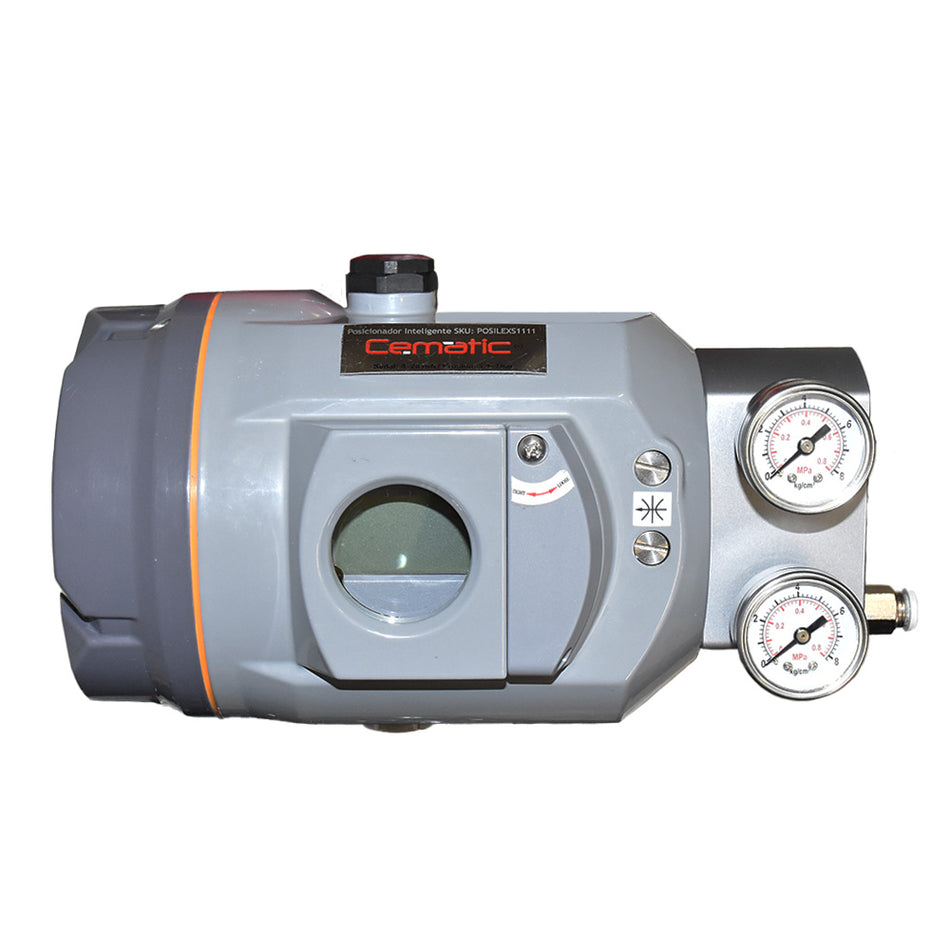
Smart Digital Rotary Positioner — Single Acting
For quarter-turn valves (ball, butterfly, plug) with single-acting pneumatic actuators. The most in-demand model in the Mexican process industry. 4–20 mA input signal with superimposed HART protocol. Hall position sensor integrated into the body. Auto-Setup in less than 60 seconds without the need for a laptop or external configurator. Local LCD display with position indication and diagnostic parameters. Direct mounting on actuator via VDI/VDE 3845 (NAMUR) kit.
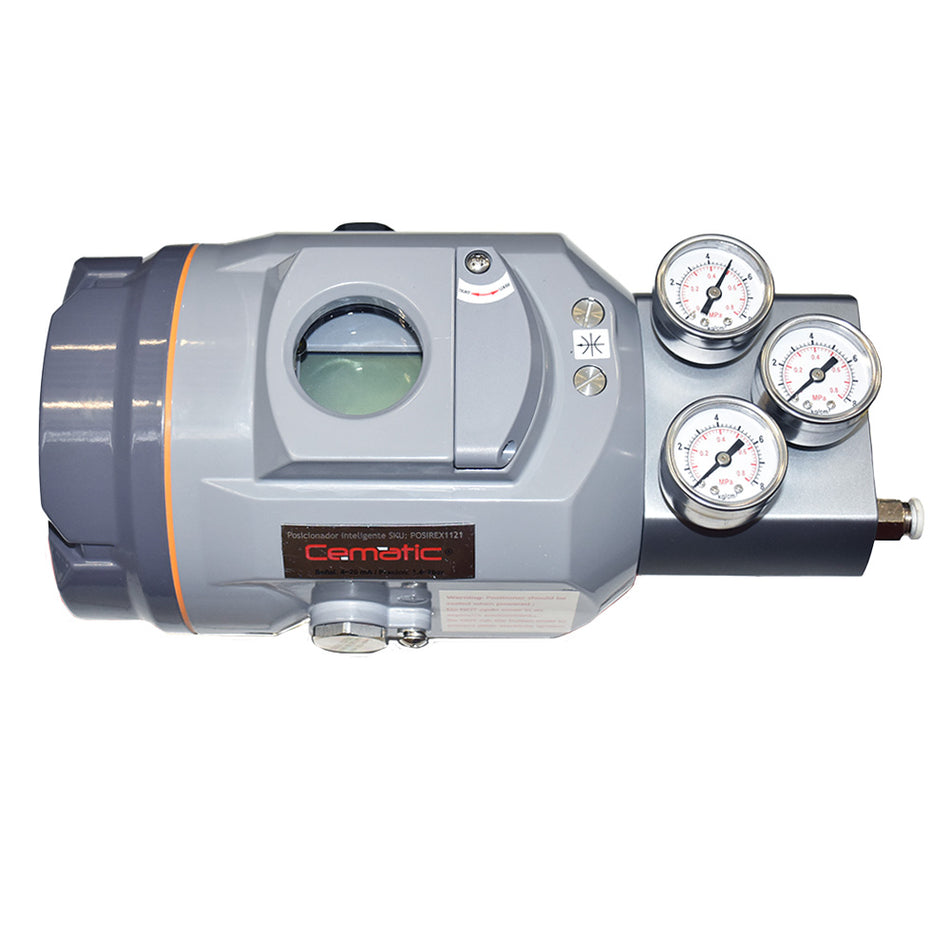
Smart Digital Rotary Positioner — Double Acting
For double-acting quarter-turn actuators where greater response force is required in both directions. Two independent air pressure outputs (output A and output B) directly control the actuator chambers. Ideal for large diameter or high differential pressure valves where a double-acting actuator is necessary to ensure closing torque.
Smart Digital Linear Positioner — Single Acting
For linear motion control valves: globe valves, diaphragm valves, and cage valves with diaphragm or pneumatic cylinder actuators. Stroke range from 10 to 100 mm. Remote Hall position sensor available for high-temperature applications (up to 105 °C) or excessive vibration where the positioner body must be physically separated from the actuator.
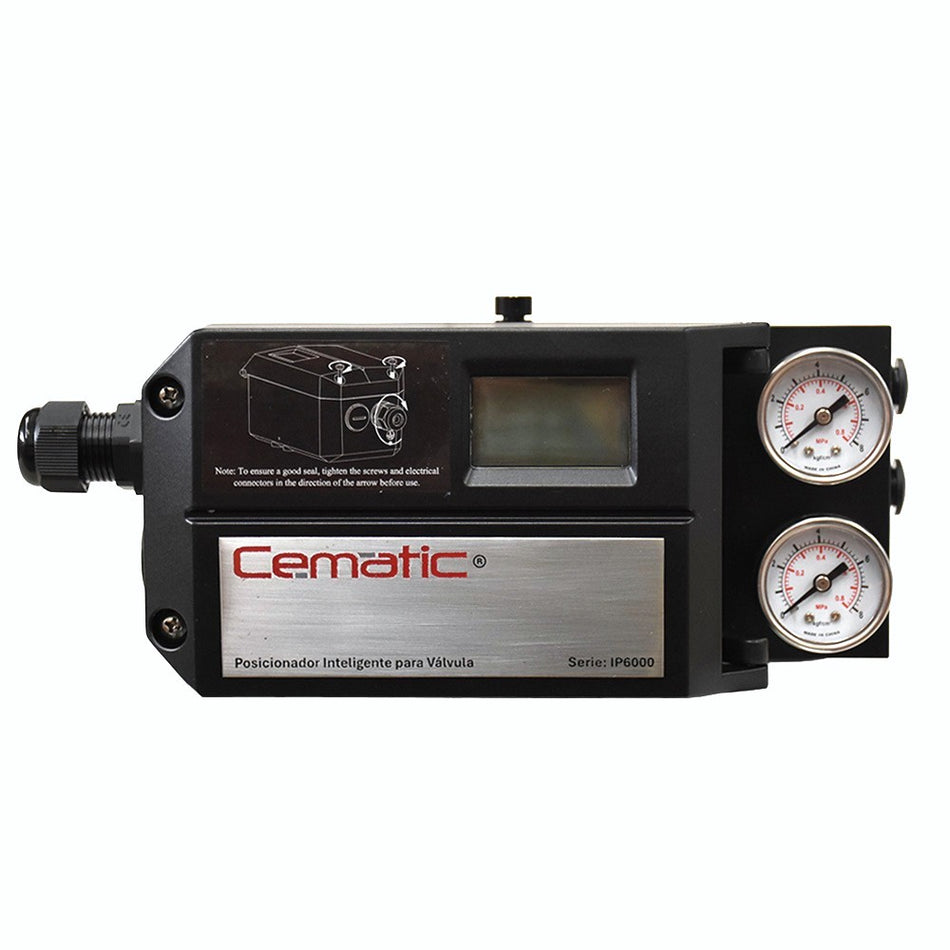
Analog Electropneumatic Positioner — Double Acting Rotary
Conventional analog version without a microprocessor. For processes where HART communication is not required and the instrumentation budget is prioritized over diagnostic capabilities. 4–20 mA signal, manual zero and span calibration, interchangeable characterization cam for linear or equal percentage. The lowest cost option for basic modulating control.
ATEX Digital Positioner — Hazardous Areas
Certified version for installation in classified areas Zone 1 and Zone 2 (gases) and Zone 21 and Zone 22 (dusts) under ATEX II 2G and IECEx regulations. Same capabilities as the standard model—HART, self-diagnostics, Auto-Setup—in a certified explosion-proof (Ex d) or intrinsically safe (Ex ia) housing. Essential in petrochemical plants, refineries, gas plants, solvent storage, and any process with potentially explosive atmospheres.
Advanced diagnostic functions — the differential value of the digital positioner
The integrated diagnostics of the digital positioner is not just technical information — it is the basis of predictive valve maintenance, the component with the greatest impact on plant availability:
- Valve Signature: The positioner strokes the valve from 0% to 100% and back while recording the torque required at each position. This characteristic curve—unique to each valve—is the digital fingerprint of the valve's mechanical state. By comparing signatures taken at different times, the maintenance engineer can detect: packing wear (increased friction), seat damage (change in the closing curve), actuator spring breakage (asymmetry between opening and closing), and trim erosion.
- Response Time (Step Response): Measures how long it takes the valve to reach a new setpoint in response to a signal step. Progressive degradation of response time indicates solid accumulation in the actuator, loss of air supply pressure, or positioner seal wear—all conditions detectable before they cause catastrophic failure.
- Cycle Counter: Records the accumulated number of operations. Allows scheduling preventive maintenance of packing and seats based on actual cycles, not arbitrary time intervals—reducing both excessive maintenance and failures due to insufficient maintenance.
- Partial Stroke Test (PST): Available in positioners for safety valves (ESD/SDV). Moves the valve 10–15% from its normal position to verify that the actuator and valve will respond correctly to an emergency shutdown demand, without completely closing the valve or interrupting the process. Required by IEC 61511 standards for instrumented safety functions (SIL).
- Position Histogram: Records the accumulated time the valve has spent in each opening range (0–10%, 10–20%, etc.). Reveals whether the valve is oversized for the process (always operates in the small opening range, where control is less precise) or undersized (always operates near 100%).
Communication Protocols — HART vs. Profibus-PA
- HART (Highway Addressable Remote Transducer): The most widely used field protocol in the process industry worldwide. HART digital communication is superimposed on existing 4–20 mA wiring, allowing analog positioners to be upgraded to digital without changing field wiring—the most important advantage for existing installations. Allows configuration, calibration, and diagnostic reading from any HART communicator (type 375, 475) or from the asset management system (AMS, PACTware, FieldCare). Communication speed: 1.2 kbps.
- Profibus-PA: Fieldbus protocol that replaces individual wiring with a shared bus where multiple positioners communicate on the same pair of wires. Higher communication speed (31.25 kbps), native integration with Siemens, ABB, and other DCS systems with Profibus-PA support. Requires a dedicated Profibus-PA segment with a bus coupler. The preferred option in new projects with modern DCS.
- Foundation Fieldbus H1: Alternative fieldbus protocol with in-field control capability (distributed control). Less common in Mexico than HART and Profibus, but available on request in specific models.
Installation and commissioning — the advantage of Auto-Setup
Manual configuration of an analog positioner—zero adjustment, span adjustment, characterization cam calibration—requires an experienced instrumentation technician and between 30 minutes and 2 hours per valve, with the process shut down. The digital positioner with the Auto-Setup function performs this process automatically:
- Press the Auto-Setup button (or send the command via HART)
- The positioner strokes the valve from end to end to detect mechanical stops
- Automatically adjusts zero, span, and internal PID loop parameters
- The valve is calibrated and ready to receive control signals
Total time: less than 60 seconds, without additional tools and with the process shut down for only the minimum necessary time. In plants with dozens or hundreds of control valves, the savings in commissioning time are significant.
General technical specifications
- Input signal: 4–20 mA with superimposed HART protocol; Profibus-PA on request
- Current consumption: 3.6 mA minimum (self-powered from the 4–20 mA loop, no auxiliary power)
- Position sensor: Non-contact Hall effect — 0.1% resolution, no friction or wear
- Positioning accuracy: ±0.5% of nominal range
- Hysteresis: < 0.5%
- Air supply pressure: 1.4 to 7 bar (20–100 psi)
- Ambient temperature: -40 °C to +85 °C (electronics); remote sensor available for process temperatures up to 150 °C
- Protection: IP66/IP67 standard
- Housing: Cast aluminum with epoxy paint; 316 stainless steel on request
- Electrical connection: M20 × 1.5 or ½" NPT
- Pneumatic connection: ¼" NPT
- Certifications: CE, ATEX II 2G Ex ia/ib IIC T4 (Ex version), IECEx
- Valve compatibility: Linear 10–100 mm stroke / Rotary 30°–120° rotation
- Actuator compatibility: Single-acting and double-acting, any manufacturer with NAMUR interface
Main industries and applications
- Chemical and petrochemical industry: Precise temperature control in reactors, pressure regulation in distillation columns, flow control of reagents in synthesis lines. Integrated diagnostics allow detection of deposit accumulation on trim before it affects the process.
- Oil and gas: Pressure regulation in production wellheads, chemical injection control, control valves in gas processing trains. ATEX version mandatory in classified areas.
- Power generation: Process steam control in thermoelectric plants, boiler feedwater regulation, combustion gas control. The digital positioner reduces instrument air consumption by up to 30% compared to analog positioners in stable processes.
- Pharmaceutical industry: Precise flow control in synthesis reactors, temperature regulation in purification and crystallization systems. The PST function allows verification of safety valves without interrupting critical batches.
- Water treatment: Control of coagulant and disinfectant dosing, flow regulation in filters and reverse osmosis systems where dosing precision directly impacts treated water quality.
- Food industry: Temperature control in pasteurizers and evaporators, flow regulation in mixers and high-precision filling systems.
- Pulp and paper: Pulp consistency regulation, temperature control in digesters and bleachers where process variability directly impacts product quality.
Why choose Cematic for your digital positioners?
We have available stock in Mexico City for the most common models: single and double-acting smart rotary positioners with HART, and ATEX versions. We advise on the selection of the correct model for your actuator type, available communication protocol in your DCS, and classified area requirements. We perform initial configuration and Auto-Setup of the positioner when supplied as part of a valve-actuator-positioner package. Technical quote on the same business day. Shipping throughout the Mexican Republic. Contact us via WhatsApp or at ventas@cematic.com.
To delve deeper into the topic, consult our technical article: Digital Positioner for Valves: What it is, How it Works, and Why it Changes Your Process.