
4Products

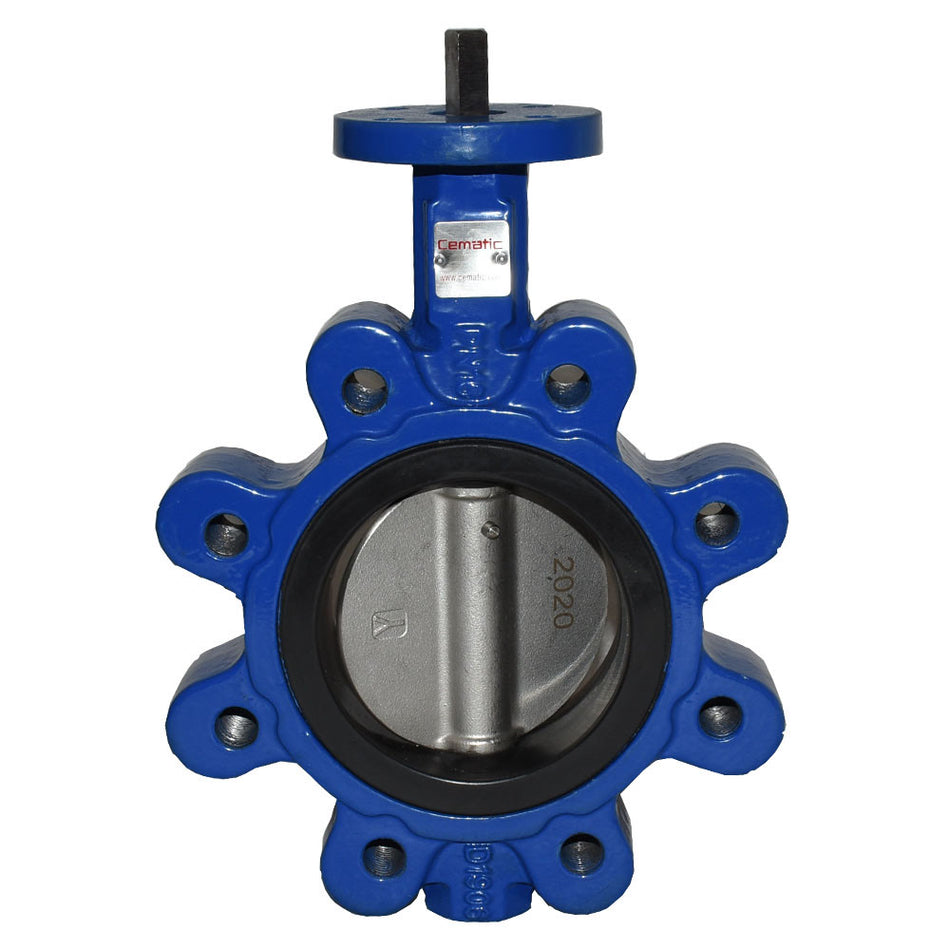


Lug Type Butterfly Valve — End-of-Line, Section Disassembly, and Maintenance Without Draining the System
The lug type butterfly valve is a specialized design within the butterfly valve family that solves a very specific operational problem: the need to disconnect or dismantle a pipe section, equipment, or accessory downstream of the valve, without having to shut down, drain, or intervene in the rest of the system operating under pressure upstream.
This capability—which conventional wafer butterfly valves lack—makes the lug valve the standard component for end-of-line service, connections to equipment requiring periodic maintenance without system shutdown, and sectionalization points where independent isolation of each network section must be guaranteed.
The Fundamental Difference Between Wafer and Lug Butterfly Valves
To understand why the lug butterfly valve exists as a separate category, it is necessary to understand the limitation of the wafer design in end-of-line applications:
Wafer Butterfly Valve — Designed for Installation Between Two Flanges
The wafer butterfly valve has no threads or self-fastening system — its position in the line is exclusively determined by the compression between the two pipe flanges and the bolts connecting them. The valve body is held by this bilateral compression. If the bolts on one side are removed, the valve becomes loose and unstable. If all bolts are removed, the valve falls. This construction has two consequences:
- The wafer butterfly valve cannot be used as an end-of-line valve (dead-end): if installed at the end of a pipe with a blind flange on one side, there is no way for the system pressure to bear solely on the valve — pressure acts on the blind flange downstream and seals it, but if that blind flange is removed, the system is completely open.
- The wafer butterfly valve does not allow the downstream section to be disassembled without removing all bolts — which simultaneously releases the valve from its position and exposes the upstream system.
Lug Butterfly Valve — Independent Fastening to Each Flange
The lug butterfly valve has threaded inserts (lugs) distributed circumferentially in the body, with a thread on each face of the body. This allows the valve to be bolted independently to the upstream flange using bolts on one side, and to the downstream flange using bolts on the other side — each set of bolts fastens the valve to its respective flange autonomously.
The practical result: when the lug butterfly valve is closed, the downstream section can be completely disassembled — by removing the bolts on the downstream side and separating the flange — without affecting the upstream side at all, which remains sealed by the closed valve fixed to its own flange by its own bolts. The system pressure remains contained upstream of the closed valve, and the technician can work on the downstream section under safe conditions.
Specific Applications Where the Lug Butterfly Valve Is the Only Correct Option
End-of-Line Service (Dead-End Service)
When the valve is installed at the end of a pipe — with the downstream side open to the atmosphere, an open tank, or equipment with no pressure on the discharge side — the system pressure acts only from the upstream side. In this condition, the lug butterfly valve, with its independent fastening to the upstream flange, withstands the full differential pressure between the system and the atmosphere without needing the downstream flange. The wafer butterfly valve cannot do this — without the downstream flange and its bolts, the wafer valve body would lack structural support.
Typical dead-end examples: Connection of sampling or purge valves at the end of a line, discharge of process lines to open tanks, access connections to maintenance equipment, drain valves for pipe sections.
Equipment Disassembly Without System Shutdown
In continuous process plants where production shutdown is costly, the lug butterfly valve allows individual equipment — pumps, heat exchangers, filters, instruments — to be isolated and disassembled for maintenance without stopping the rest of the system. The procedure is: close the lug butterfly valve, remove the bolts on the downstream side (towards the equipment), disconnect the equipment for maintenance or replacement, and reconnect the equipment by reattaching the bolts. The upstream system remains in normal operation throughout the process.
Sectionalization Points with Guaranteed Isolation
In industrial fluid distribution networks where it is necessary to ensure that when a valve is closed, the adjacent section can be safely intervened, the lug butterfly valve provides the structural isolation — not just the seat seal — that guarantees physical separation between the two sections. The installer can remove the flange of the section to be intervened with the certainty that the valve will remain structurally fixed in position, containing the system pressure.
Lug Body Construction — The Details That Matter
The threaded inserts (lugs) that give this design its name can be implemented in two ways, with distinct technical implications:
- Through-Threaded Lugs: The thread goes through the entire body thickness — the bolt from side A and the bolt from side B share the same threaded insert (one enters from each face). This configuration is cheaper to manufacture but has the limitation that when the bolt on one side is removed, the insert is temporarily exposed. It is not the recommended configuration for dead-end service with high differential pressure.
- Double-Threaded Lugs: Each body face has its own independent threaded insert — a complete set of inserts on face A and another complete set on face B. This is the correct configuration for dead-end service and for disassembly under differential pressure, as each side is completely independent of the other structurally.
When quoting a lug butterfly valve for end-of-line service with significant differential pressure, explicitly specify the double independent lug configuration and confirm the maximum working differential pressure for the empty downstream side.
Available Materials
Cast Iron GG25 with EPDM Seat
For general water, HVAC, wastewater, and non-corrosive industrial process services. The cast iron body with vulcanized EPDM seat covers most lug applications in water infrastructure and general processes where corrosion resistance is not the primary criterion.
- Temperature: Up to 130 °C with EPDM
- Pressure: PN10 / PN16
- Diameters: DN50 to DN600
- Disc: Stainless steel SS316
Cast Iron GG25 with NBR Seat
For services with mineral oils, fuels, and hydrocarbons where EPDM is not compatible. The cast iron lug butterfly valve with NBR covers end-of-line applications in lubrication systems, fuel distribution, and process oils.
Cast Iron GG25 with Viton (FKM) Seat
For service with organic solvents, aromatic hydrocarbons, and temperatures up to 180 °C where EPDM and NBR are not sufficient. The cast iron lug butterfly valve with Viton is the option for end-of-line applications in chemical processes with more aggressive fluids.
Stainless Steel 316 with EPDM or PTFE Seat
For services where cast iron is insufficient due to corrosion resistance: seawater, saline solutions, moderate acidic or alkaline water, non-sterile food processing industry. PTFE seat for greater chemical resistance or moderate temperature.
- Body: CF8M (SS316 equivalent in casting)
- Disc: Stainless steel SS316
- Temperature with PTFE: Up to 150 °C
Technical Specifications
- Mounting Type: Lug — threaded inserts in the body for independent fastening to each flange
- Difference from wafer: Bolts thread directly into the body inserts of the valve — they do not pass through the valve from flange to flange
- Nominal Diameters: DN50 (2") to DN600 (24")
- Nominal Pressure: PN10 and PN16 standard
- Temperature: According to selected seat (see materials)
- Design Standard: EN 593 / API 609 Category A
- Face-to-Face: ASME B16.10 / EN 558-1
- Flange Connection: DIN 2501 / ANSI B16.5
- Actuator Interface: ISO 5211 — compatible with quarter-turn pneumatic and electric actuators
- Factory Test: Hydrostatic body test and seat tightness test according to EN 12266 / API 598
Differential Pressure Capacity in Dead-End Service
The maximum differential pressure that the lug butterfly valve can withstand in end-of-line service (with the downstream side empty) is less than its normal nominal service pressure between two flanges. This occurs because in normal service, both sides of the valve are pressurized by the system pressure — the pressure acts on the seat from both sides, and the net force on the disc is the difference. In dead-end, all system pressure acts on the disc from only one side, generating a much greater net force on the seat and the valve structure.
The maximum differential pressure in dead-end must be consulted in the manufacturer's pressure table for each specific model. As a general reference, a PN16 lug butterfly valve can withstand dead-end differential pressures of 5 to 10 bar depending on the diameter and the specific lug design. For dead-end applications at higher pressures, specify a high-performance lug butterfly valve or ball/gate valve.
Wafer vs. Lug — Decision Guide
| Situation | Wafer Butterfly Valve | Lug Butterfly Valve |
|---|---|---|
| Valve between two permanent pipe sections | ✅ First choice — more economical | Possible but unnecessarily costly |
| End-of-line (dead-end) with blind flange | ❌ Not suitable — no support at the end | ✅ The only correct option |
| Disassemble downstream equipment without system shutdown | ❌ Requires removing all bolts | ✅ Downstream section safely detachable |
| Distribution system with multiple branches | ✅ Sufficient in most cases | ✅ Preferable at critical sectionalization points |
| Permanent installation without access for maintenance | ✅ Suitable | ✅ Suitable |
| Relative cost | ✅ Lower | Higher — justified in dead-end applications |
| Equipment replacement without system draining | ❌ Not safely possible | ✅ Standard and safe procedure |
Operation and Automation
The lug butterfly valve is operationally identical to the wafer butterfly valve — the same operation options apply:
- Manual lever with lock: For DN50–DN150 with low operating frequency
- Gear reducer: For DN200–DN600 where torque exceeds lever capacity
- Quarter-turn pneumatic actuator: For ON/OFF automation. Especially relevant in lug butterfly valves for dead-end service where automatic closing upon an emergency signal may be a safety requirement — the normally closed single-acting actuator ensures closure upon air supply failure.
- Electric actuator: For installations without a compressed air network or with 4–20 mA modulating control
See automation packages: Butterfly Valves with Pneumatic Actuator → / With Electric Actuator →
Main Industries and Applications
- Water treatment plants (WTTP and WWTP): The lug butterfly valve is the standard for inlet and outlet connections of process equipment that require periodic maintenance without shutting down the entire plant: sand filters, activated carbon filters, reverse osmosis membranes, heat exchangers. By closing the lug upstream of the equipment, the equipment can be removed for cleaning or replacement while the rest of the system continues to operate.
- Large-scale HVAC systems: Inlet and outlet connections of chillers, cooling towers, and air handling units in centralized air conditioning systems. The lug butterfly valve allows isolation and disassembly of each individual piece of equipment for preventive maintenance without affecting the water circuit which continues to circulate through the other units.
- Chemical industry — connections to reactors and process equipment: End-of-line connections in batch reactors where the feed or discharge line terminates at the reactor nozzle. The lug butterfly valve allows the line to be disconnected from the reactor for cleaning or service change without affecting the supply line under pressure.
- Pumping stations — pump maintenance: A lug butterfly valve downstream of each pump (in the discharge line) allows the pump to be isolated and removed for maintenance without draining the main distribution line. The lug butterfly valve replaces the pump-valve-blind flange pair that would be necessary with a wafer butterfly valve.
- Food and beverage plants — connections to equipment with CIP: Connection points for pasteurizers, sterilizers, and process equipment that are periodically removed for deep cleaning. The SS316 lug butterfly valve with EPDM allows the equipment to be isolated from the main line without needing to drain the process loop.
- Industrial gas infrastructure: End-of-line connections in nitrogen, CO₂, and other industrial gas distribution where the lug butterfly valve acts as a shut-off valve at the gas distribution end, allowing safe connection and disconnection of consuming equipment without purging the main line.
- Mining — connections to equipment with frequent maintenance: Slurry pumps, filter presses, and process equipment in beneficiation plants that require frequent maintenance. The lug butterfly valve in iron or SS316 depending on the fluid allows quick replacement of equipment without shutting down the main line.
Why Choose Cematic for Your Lug Type Butterfly Valves?
We have stock available in Mexico City for the most demanded diameters of cast iron lug butterfly valves with EPDM. We advise on the selection of the correct body and seat material for the specific fluid, and on verifying the maximum acceptable differential pressure in dead-end service for the selected model — critical technical information that is often not consulted and can result in valve failure in service. For high-differential pressure dead-end applications, we recommend alternatives when the standard lug butterfly valve is not sufficient. Technical quotes on the same business day. Shipping throughout the Mexican Republic. Contact us via WhatsApp or at ventas@cematic.com.