
8Products
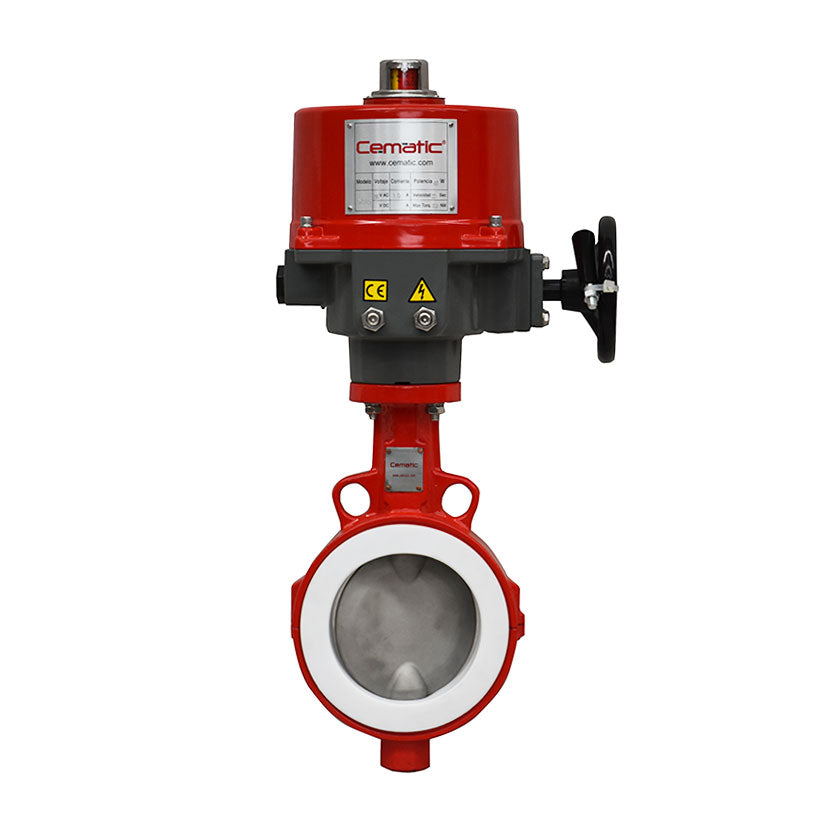

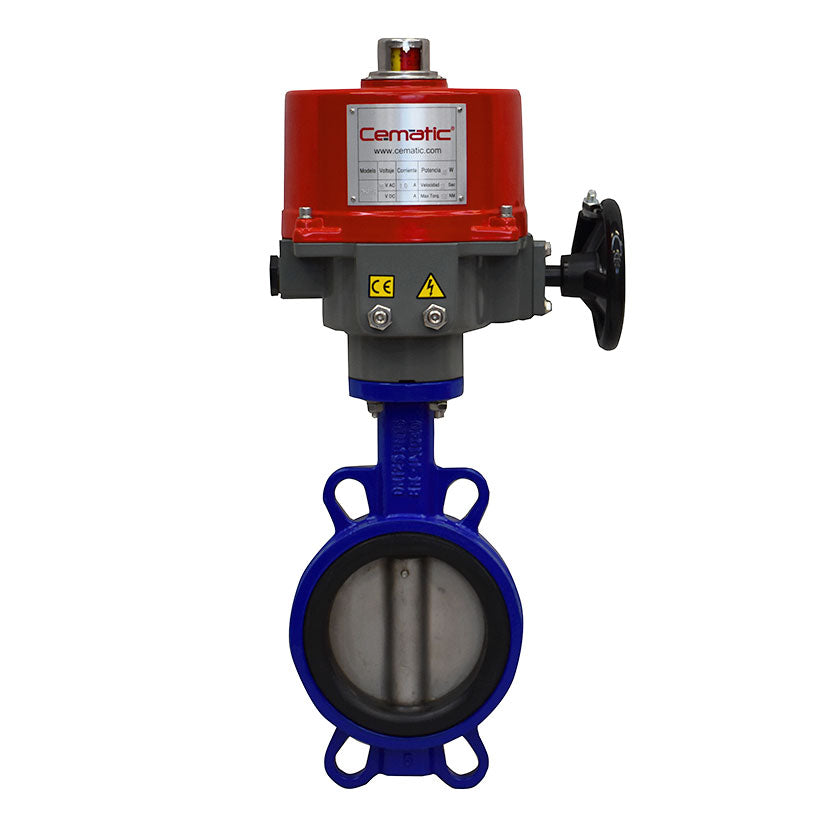


Butterfly Valve with Electric Actuator | ON/OFF and 4-20mA | Cematic Mexico
The butterfly valve with electric actuator solves the main bottleneck of pneumatic automation: the need for a compressed air network at every control point. Where there is no compressed air piping, where the cost of installing it is prohibitive, or where direct digital integration with the control system is a priority, the electric actuator is the technically and economically correct solution. It operates on the electrical supply already available in any industrial facility, connects directly to PLC or DCS outputs, and provides real-time position feedback without additional accessories.
At Cematic, we supply butterfly valves with electric actuators as complete, assembled, and shop-tested packages in Mexico City. Each package includes the valve selected for your fluid, the actuator correctly sized for the required torque, and the control signal configuration suitable for your system: ON/OFF with a digital signal, modulating with a 4–20 mA or 0–10 V signal, or with the Modbus RTU communication protocol for advanced integration.
Electric Actuator vs. Pneumatic Actuator — When to Choose Electric?
Both operate the same quarter-turn of the valve, but their characteristics make them ideal for different installation conditions. There is no universal answer — the correct choice depends on the available infrastructure and process requirements:
| Criterion | Electric Actuator | Pneumatic Actuator |
|---|---|---|
| Required power source | ✅ Electrical wiring only | 4–8 bar compressed air network |
| Operating speed | Moderate — 5 to 60 seconds depending on size | ✅ Fast — 1 to 5 seconds |
| 4–20 mA modulating control | ✅ Native in most models | Requires an additional positioner |
| Digital communication | ✅ Native Modbus RTU, PROFIBUS, BACnet | Requires a positioner with HART/Profibus |
| Exact position indication | ✅ 4–20 mA feedback signal included | Only with an additional transmitter |
| Last position memory | ✅ Standard fail-last (no spring) | Only with double action |
| Installation in remote areas | ✅ Cable only — no air piping | Requires pneumatic piping to the point |
| Cost in frequent cycles | Motor may overheat in very fast cycles | ✅ Millions of cycles without degradation |
| Intrinsically safe ATEX zones | ATEX version available (higher cost) | ✅ No electrical components in the valve |
| Integration with building BMS / SCADA | ✅ Native BACnet, Modbus TCP/IP | Requires additional I/O |
Choose an electric actuator when: No compressed air network is available, the process requires precise modulating control without an additional positioner, you need direct digital communication (Modbus, BACnet), the cycle frequency is less than 20 operations per hour, or the installation is in a building or area without pneumatic infrastructure.
Choose a pneumatic actuator when: A compressed air network already exists, response speed is critical (cycles in seconds), the frequency is very high (hundreds of cycles per hour), or the area is ATEX where the pneumatic actuator is intrinsically safer and more economical.
Electric Actuator Operating Modes
ON/OFF Control (Full Open/Close)
The simplest mode. The valve operates only between two positions: 0° (fully closed) and 90° (fully open). The actuator receives a digital signal from the PLC — dry contact, 24 VDC or 110/220 VAC — and brings the valve to the corresponding position. There are no intermediate positions. It is the most reliable mode, requiring the least sophisticated and lowest-cost actuator. Ideal for batch open/close sequences, section isolation valves, and any application where only "pass" or "no pass" of the fluid is needed.
- Input signal: dry contact, 24 VDC, 110 VAC or 220 VAC depending on the model
- Feedback: 2 integrated limit switches (open/closed)
- Safety torque: the motor stops automatically upon reaching the mechanical opening and closing stops
Modulating Control with 4–20 mA / 0–10 V Signal
The actuator positions the butterfly valve disc at any angle between 0° and 90° proportionally to the controller input signal. At 4 mA (or 0 V), the valve is closed; at 20 mA (or 10 V), it is fully open; at 12 mA (or 5 V), it is 50% open. This mode converts the butterfly valve into a flow, pressure, or temperature control element within a PID loop. The position feedback signal (4–20 mA output) confirms the actual position of the valve to the controller in real time.
- Input signal: 4–20 mA (2-wire) or 0–10 V (3-wire) depending on the model
- Position feedback: 4–20 mA output signal proportional to the position
- Positioning accuracy: ±1–2% of the nominal range
- Hysteresis: ≤ 1%
- Travel time (0% to 100%): adjustable — typically 15 to 60 seconds depending on size
Control with Digital Protocol — Modbus RTU / BACnet / PROFIBUS
Advanced electric actuators integrate industrial communication protocols that allow the valve to be fully controlled and monitored from the control system without additional analog signal wiring. Via Modbus RTU (RS-485), the control system can:
- Send the position setpoint with 0.1% resolution
- Read the actual position of the valve in real time
- Read the operating torque and detect obstructions
- Read the number of accumulated cycles and the motor temperature
- Configure stroke limits, speed, and response parameters
- Receive failure alarms (overheating, position failure, signal loss)
BACnet MS/TP is available in specific models for integration with building management systems (BMS) in HVAC, hot/cold water plants, and climate control in smart buildings.
Fail-Safe Modes
Unlike the pneumatic actuator —where the spring ensures the fail position passively— the electric actuator requires a specific design for each fail-safe mode:
- Fail-Last (standard): In the event of a power outage, the valve maintains its last position. The self-locking mechanism of the gear reducer immobilizes the disc without consuming energy. The most common and economical mode — suitable when the last position is acceptable as a safe state.
- Fail-Open or Fail-Close with backup battery: A lithium battery or capacitors integrated into the actuator maintain enough energy to bring the valve to the predefined fail-safe position in the event of a power outage. The actuator detects the loss of power and executes the emergency movement in less than 5 seconds before exhausting the energy reserve.
- Fail-Safe with mechanical spring (Spring Return): Available in specific models. Combines the electric motor with a return spring that brings the valve to the safe position upon loss of power, without relying on a battery. Greater reliability for SIL applications where the safety function cannot depend on batteries.
Technical specifications of the electric actuator
- Supply voltage: 24 VDC, 110 VAC or 220 VAC / 50–60 Hz depending on the model
- Available torque: 5 Nm to 3,000+ Nm depending on the actuator size
- IP protection: Standard IP67 for outdoor use and wet environments; IP68 available
- Ambient temperature: Standard -20 °C to +70 °C; -40 °C to +70 °C in low-temperature versions
- Motor temperature: Integrated thermal protection — automatic shutoff upon overheating
- Valve interface: ISO 5211 — compatible with butterfly valves from all manufacturers that meet the standard
- Travel time 0°–90°: 15 s, 30 s, 60 s, 90 s or 120 s depending on model and size — adjustable in some models
- Service class: S2 (intermittent service) — the electric actuator is not suitable for continuous high-frequency open/close cycles
- Certifications: CE; ATEX Ex II 2G versions available for hazardous areas
- Display and local configuration: LCD screen with position indication, parameter configuration menu without a laptop
Available butterfly valve materials
- Cast Iron / Carbon Steel — EPDM or NBR Seat: For potable water, process water, HVAC, heating systems, and non-corrosive general services. The most economical combination. Available from DN50 to DN600.
- Stainless Steel 316 — EPDM, NBR or PTFE Seat: For the food industry, pharmaceutical, moderate chemical, and fluids with hygiene or corrosion resistance requirements. DN50 to DN300.
- Anti-corrosive with PTFE Liner: PTFE-coated interior for moderately corrosive fluids in the chemical and water treatment industry. DN50 to DN200.
- High Performance (Double Eccentricity): For high pressure, high temperatures, and fluids with greater differential pressure. Metal or reinforced PTFE seat. DN50 to DN400.
- Hygienic Sanitary: Polished SS316L Ra ≤ 0.8 µm for the food, beverage, and pharmaceutical industry. DN50 to DN200.
Main industries and applications
- HVAC and building management: The most frequent application of the electric actuator with BACnet or Modbus communication. Zone valves in chilled water and hot water systems, flow control in fan coil units, fancoils, and air handling units. Direct integration with the BMS without pneumatic infrastructure makes the electric actuator the absolute standard in this sector.
- Potable and wastewater treatment: Remote control of valves in treatment plants, pumping stations, and distribution networks where there is no compressed air supply. 4–20 mA signal for proportional dosing of reagents or Modbus for integration with SCADA for remote operation.
- Food and pharmaceutical industry: Filling and emptying sequences controlled by recipe from the MES or PLC system. The electric actuator allows direct integration with recipe controllers (batch control) without pneumatic infrastructure in clean areas where the air compressor can be a source of contamination.
- Chemical industry in facilities without air network: Small and medium plants, production laboratories, and pilot units where installing an air compressor and its distribution network is not economically justifiable. The electric actuator allows automating valves with only the existing electrical wiring.
- Renewable energy and solar plants: Valve control in panel cooling systems, hot water cycles in solar thermal plants, and energy management systems where Modbus integration with the plant controller is a priority.
- Precision agriculture and technical irrigation: Automation of irrigation sections without air compressors. Low-power electric actuators (24 VDC) can operate with solar panels, making automation possible in locations without access to a conventional electrical grid.
- Mining in remote locations: Control valves in water distribution systems and reagent dosing where the only available infrastructure is low-voltage electrical wiring from local generators.
Specific applications where the electric actuator is superior to the pneumatic
- Proportional temperature control in heat exchangers: The controller PID loop continuously adjusts the position of the butterfly valve via a 4–20 mA signal. The electric actuator responds directly without an additional positioner, simplifying installation and reducing failure points.
- Hydraulic balancing valves in distribution networks: Precise positioning at a fixed angle determined by hydraulic calculation. The position memory (fail-last) ensures that in the event of a power outage, the valve maintains the system balance until power is restored.
- Integration with agricultural irrigation controllers: Modern irrigation controllers have 24 VDC digital outputs or dry contact relays directly compatible with ON/OFF electric actuators — without signal converters or additional infrastructure.
- Remote control systems via SCADA in water plants: The electric actuator's Modbus RTU protocol is native in all SCADA systems on the market, allowing the monitoring and control of dozens of valves from a central control room with RS-485 wiring in daisy chain.
Why choose the Cematic butterfly valve with electric actuator package?
At Cematic, we deliver the complete assembly: valve selected for your fluid and pressure, actuator sized with a verified torque safety factor, configured for your control signal (ON/OFF, 4–20 mA or Modbus), and tested in the shop before shipping. You receive an assembly ready to install and connect — without the need to verify interface compatibility, calculate torque, look for adapters, or configure actuator parameters in the field.
- ✅ Technical selection with verified torque calculation
- ✅ Control signal configuration (ON/OFF / 4–20 mA / Modbus) before shipping
- ✅ Complete functional test — opening, closing, position feedback
- ✅ Advice for integration with your PLC, BMS or control system
- ✅ Stock available in Mexico City for the highest turnover models
- ✅ Technical quote on the same business day — shipping throughout the republic
Contact us via WhatsApp or at ventas@cematic.com.