
5Products
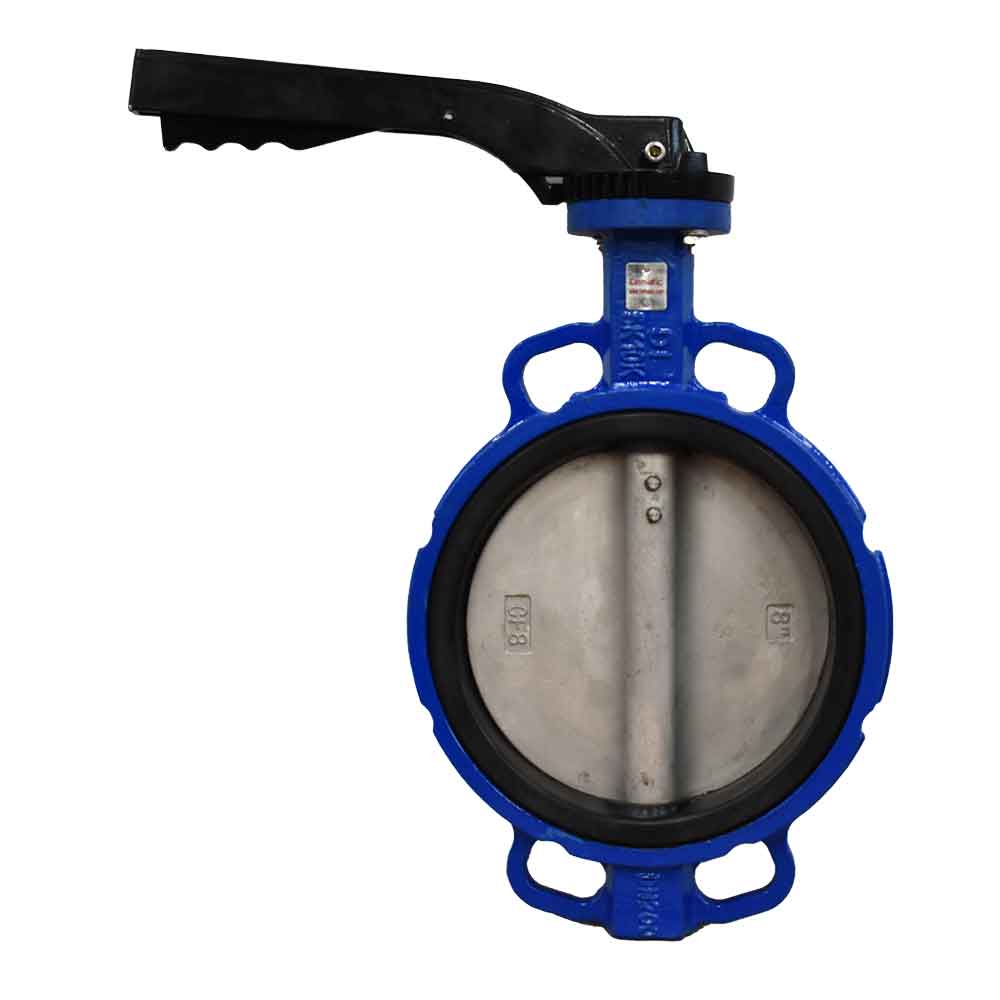


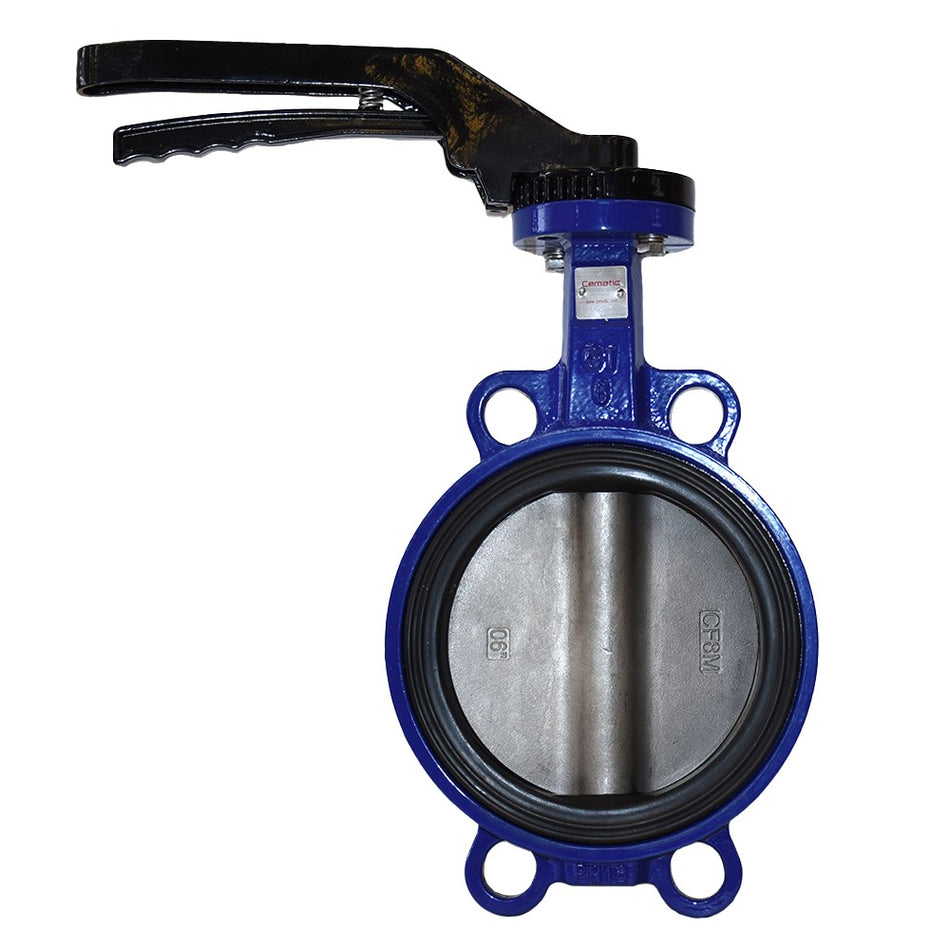


Cast Iron and Carbon Steel Wafer Butterfly Valves — The Most Cost-Effective Isolation Solution for Medium and Large Diameters
The cast iron or carbon steel wafer butterfly valve with an elastomeric seat is the most widely installed isolation valve in Mexico in potable water, cooling water, wastewater, HVAC, irrigation, general industrial process, and fire protection systems. Its popularity is due to a combination of factors that no other isolation valve can simultaneously match in medium and large diameters: significantly lower cost per DN than gate or ball valves, up to 10 times less weight than an equivalent gate valve, compact installation between flanges without its own body, and simple quarter-turn operation with a lever or gear reducer. The vulcanized rubber seat that completely covers the inside of the body provides a tight seal and protects the cast iron from direct contact with the fluid.
At Cematic, we supply this range in the diameters most in demand by the Mexican industry: from DN50 (2") to DN1200 (48") in the largest diameters, with a GG25 cast iron body for water and general process services, and WCB carbon steel for services with higher mechanical or temperature requirements. Standard disc in SS316 stainless steel for resistance to fluid corrosion in any opening position.
The elastomeric seat — the key to the correct selection
The seat material determines the chemical compatibility of the valve with the process fluid and its operating temperature range. It is the first parameter to define when specifying a butterfly valve, and the most common error that causes premature seat failure:
EPDM (Ethylene-Propylene-Diene Monomer) — The Universal Seat for Water and General Services
EPDM is the reference elastomer for the vast majority of water and aqueous process applications. Its resistance to aging, ozone, UV rays, and hot water makes it the most durable seat in potable water, industrial water, and aqueous fluid conditions. It is the standard seat that Cematic recommends as the first choice when there are no special fluid requirements.
- Compatible with: Potable water (NSF/ANSI 61 in specific models), seawater, industrial water, cooling water, wastewater, low-pressure steam (up to 3 bar), chlorine solutions (up to 5 ppm residual), NaOH up to 10%, very low concentrations of diluted acids, alcohols, HVAC, fire protection systems
- Not compatible with: Mineral oils, fuels, hydrocarbons, organic solvents (toluene, xylene, acetone), gasoline, diesel — EPDM swells and loses mechanical resistance with these fluids
- Operating temperature: -30 °C to +130 °C in continuous service; up to 150 °C for short periods
- Identification color: Black or dark gray in most manufacturers
NBR (Nitrile Butadiene — Acrylonitrile Butadiene Rubber) — For Oils, Fuels, and Hydrocarbons
NBR (also called nitrile or Buna-N) is the specific elastomer for service with hydrocarbon-based fluids: mineral oils, vegetable oils, liquid fuels, lubricating and hydraulic oils. Its resistance to hydrocarbon diffusion into the elastomer matrix makes it the correct seat where EPDM would fail in days.
- Compatible with: Mineral oils, vegetable oils, gasoline, diesel, fuel oil, hydraulic oils, transmission oils, kerosene, some concentrated acids, water with oil content
- Not compatible with: Hot water above 80 °C (hydrolysis destroys NBR), steam, strong acids, ozone, chlorinated solvents, ketones (acetone, MEK), esters — NBR hardens and cracks with prolonged exposure
- Operating temperature: -20 °C to +100 °C in oils; maximum 80 °C in water
- Identification color: Black — visually indistinguishable from EPDM; always check the seat marking
Viton / FKM (Fluorocarbon Elastomer) — For Solvents, Aromatic Hydrocarbons, and High Temperatures
Viton (the brand name for FKM from Chemours, formerly DuPont) is the most chemically resistant elastomer available in butterfly valves. Its fluorine-based molecular structure gives it resistance to practically all fluids that destroy EPDM and NBR: aromatic hydrocarbons, chlorinated solvents, concentrated ketones and esters, and fluids at temperatures that exceed the limits of the other elastomers.
- Compatible with: Toluene, xylene, benzene, chlorinated solvents (DCM, TCE, perchloroethylene), ketones (acetone, MEK, MIBK), esters, moderately concentrated acids, high-temperature fluids, aromatic gasolines, hydrocarbon mixtures, fluorinated fluids
- Not compatible with: Methanol and some low-molecular-weight alcohols in high concentrations, anhydrous ammonia, amines, phosphate esters — check the specific compatibility chart for exact conditions
- Operating temperature: -15 °C to +200 °C in continuous service — the widest range of the three elastomers
- Relative cost: 3 to 5 times higher than EPDM and NBR — justified in applications where the other elastomers would fail
- Identification color: Typically brown or orange — although it varies by manufacturer
Quick seat selection guide by fluid
| Fluid | EPDM | NBR | Viton |
|---|---|---|---|
| Potable water / industrial water | ✅ First choice | ⚠️ Possible | ✅ Compatible |
| Seawater / brine | ✅ First choice | ⚠️ Possible | ✅ Compatible |
| Hot water (>80 °C) | ✅ First choice | ❌ Not compatible | ✅ Compatible |
| Low-pressure steam (<3 bar) | ✅ Compatible | ❌ Not compatible | ✅ First choice |
| Wastewater / blackwater | ✅ First choice | ⚠️ Only if oil-free | ✅ Compatible |
| Mineral / hydraulic oil | ❌ Not compatible | ✅ First choice | ✅ Compatible |
| Gasoline / diesel / fuel oil | ❌ Not compatible | ✅ First choice | ✅ Compatible |
| Toluene / xylene / aromatics | ❌ Not compatible | ⚠️ Limited resistance | ✅ First choice |
| Acetone / MEK / ketones | ❌ Not compatible | ❌ Not compatible | ✅ First choice |
| Chlorinated solvents (DCM, TCE) | ❌ Not compatible | ❌ Not compatible | ✅ First choice |
| NaOH up to 10% | ✅ Compatible | ❌ Not compatible | ✅ Compatible |
| Sodium hypochlorite NaClO up to 5 ppm | ✅ Compatible | ❌ Not compatible | ✅ Compatible |
| Compressed air | ✅ Compatible | ✅ Compatible | ✅ Compatible |
| Dry natural gas | ⚠️ Check pressure | ✅ Compatible | ✅ First choice |
⚠️ For fluids not listed or borderline conditions (temperatures or concentrations at the edge of the range), consult our technical team — we perform chemical compatibility verification at no cost.
Body materials — cast iron vs. carbon steel
GG25 Cast Iron (ASTM A48 / EN-GJL-250)
The standard material for the vast majority of water, HVAC, and general industrial process applications. GG25 cast iron offers excellent compressive strength, good machinability, and a significantly lower cost than carbon steel for the same volume of material. Its main limitation is brittleness under impact and extreme vibrations — in installations with a high risk of water hammer or severe mechanical vibrations, ductile (nodular) iron or carbon steel is preferable.
- Typical applications: Potable and wastewater, HVAC, irrigation systems, cooling water, municipal distribution networks, fire protection systems
- Maximum temperature: 120 °C with standard EPDM seat
- Nominal pressure: PN10 and PN16 in most models
WCB Carbon Steel (ASTM A216)
For applications with higher mechanical demands: higher operating pressure, greater impact resistance (against water hammer), higher temperature, or service with industrial fluids that require the highest mechanical resistance from the steel body. WCB carbon steel has higher tensile strength and greater toughness than cast iron, making it the correct choice when the service involves pressure fluctuations, frequent pump starts, or installations in high-energy systems.
- Typical applications: High-pressure pumping stations, industrial systems with frequent starts, oil and industrial process at higher pressures, lines with a high risk of water hammer
- Maximum temperature: According to the selected elastomeric seat — the WCB body does not limit the temperature within the ranges of the elastomers
- Nominal pressure: Typically PN16 and PN25
Disc — standard SS316 stainless steel
The butterfly valve disc remains inside the flow even in the fully open position — unlike a gate valve where the wedge moves completely out of the flow area. This means that the disc material determines the chemical compatibility of the valve with the fluid in continuous service, not just in the closed position. The standard disc in SS316 stainless steel provides:
- Corrosion resistance in potable water, seawater, brine solutions, and most industrial aqueous fluids
- Resistance to residual chlorine at typical tap water concentrations (up to 5 ppm)
- Compatibility with most chemicals at moderate concentrations
- Surface finish that minimizes the deposition of calcareous deposits
For fluids where SS316 is not sufficient (concentrated acids, some strong alkalis), the correct choice is the corrosion-resistant butterfly valve with PTFE liner →
Technical specifications
- Type: Wafer — between-flange mounting without its own connection body
- Body: GG25 cast iron or WCB carbon steel depending on the model
- Disc: Standard SS316 stainless steel
- Shaft / stem: Two-piece SS316 stainless steel (upper and lower)
- Seat: EPDM, NBR, or Viton (FKM) vulcanized to the body — field-replaceable in specific models
- Nominal diameters: DN50 (2") to DN1200 (48") — stock availability varies by diameter
- Nominal pressure: PN10 / PN16 (cast iron) — PN16 / PN25 (carbon steel)
- Operating temperature: -20 °C to +130 °C with EPDM; -20 °C to +100 °C with NBR; -15 °C to +200 °C with Viton
- Design standard: EN 593 / ISO 5752
- Factory test: Body hydrostatic test and seat tightness test according to EN 12266 / API 598
- Between-flange connection: DIN 2501 / ANSI B16.5 depending on the model
Available operation
Manual Lever with Lock
For DN50 to DN200 (2"–8") with low operating frequency. The lever includes a locking system in discrete positions every 10°, allowing adjustment to intermediate partial opening positions for manual flow control. Instant quarter-turn operation. Steel or aluminum alloy lever depending on the model.
Manual Gear Reducer
For DN200 to DN1200 (8"–48") where the operating torque exceeds the ergonomic capacity of a direct lever. The reducer multiplies the operator's effort through the handwheel, allowing large-diameter valves to be operated with minimal force. Available with a position indicator and adjustable end stops. Option with padlock closure for safety locking in the open or closed position.
Quarter-Turn Pneumatic Actuator
For ON/OFF automation with fast cycles (1–5 seconds) and high operating frequency. The pneumatic rack and pinion actuator with ISO 5211 interface mounts directly on the butterfly valve without adapters, in single-acting (NC or NO for fail-safe) or double-acting (fail-last) configuration. The NAMUR control solenoid mounts directly on the actuator without intermediate piping. Compatible with ATEX solenoids for classified areas.
See the complete package: Butterfly Valves with Pneumatic Actuator →
Electric Actuator
For installations without a compressed air network or where integration with a 4–20 mA signal is required for modulating flow control, or with the Modbus protocol for SCADA integration. Available in 24 VDC, 110 VAC, and 220 VAC. IP67 protection for outdoor use. Typical operating time 15–60 seconds for the full 0° to 90° stroke.
See the complete package: Butterfly Valves with Electric Actuator →
Wafer butterfly valve vs. gate valve — quick selection guide
The most frequent question when specifying isolation in medium and large diameters is choosing between a wafer butterfly valve and a gate valve. This table simplifies the decision:
| Criterion | Wafer Butterfly Valve | Nodular Iron Gate Valve |
|---|---|---|
| Cost at DN150–DN600 | ✅ Significantly lower | Higher — especially at DN300+ |
| Weight and axial space | ✅ Very compact and lightweight — installation without equipment | Greater weight and axial length |
| Pressure drop when open | ⚠️ Disc in the flow — slightly higher than gate | ✅ Minimal — wedge out of the flow path |
| Line pigging | ❌ Not compatible — disc obstructs the flow path | ✅ Compatible at DN300+ with full bore |
| Operating frequency | ✅ High — frequent operation without excessive wear | Low — not recommended for high frequency |
| Partial flow control | ✅ Possible with locking lever | ❌ Not recommended — damages the wedge |
| Underground installation | ⚠️ Requires side access for lever | ✅ Non-rising stem for burial |
| Automation | ✅ Direct with quarter-turn actuator | Requires linear or multi-turn actuator |
| Fire protection system (NFPA) | ⚠️ Requires position monitoring | ✅ Standard NFPA 13 OS&Y valve |
Main industries and applications
- Potable water and municipal distribution systems: The cast iron wafer butterfly valve with EPDM is the de facto standard for sectionalizing points in distribution networks where the valve is installed in an accessible chamber. At DN300 to DN1200, the cost difference compared to the gate valve is decisive for the budgets of operating agencies. The EPDM seat resists the residual chlorine of the tap water without degradation.
- Potable water treatment plants (PTAP) and wastewater treatment plants (PTAR): Isolation of clarifiers, filters, clarifiers, and chlorine contact tanks. The cast iron wafer butterfly valve allows quick closure and operation from the control panel when automated with an electric actuator with Modbus. The large diameters in PTAR (DN400–DN800) make the cast iron butterfly valve with EPDM the only economically viable option.
- HVAC and industrial climate control: Chilled water and hot water circuits in commercial buildings, hospitals, data centers, and industrial facilities. The cast iron butterfly valve with EPDM and electric actuator with BACnet signal is the standard component of modern building management systems (BMS). The reduced torque of the butterfly valve allows smaller electric actuators with lower energy consumption.
- Agricultural irrigation and aquaculture: Control of drip, sprinkler, and center-pivot irrigation zones. Irrigation heads in large-scale agricultural operations. Aquaculture ponds where seawater and suspended solids make EPDM the correct seat. PVC butterfly valves are preferable for these applications in small diameters — see PVC Valves →; for DN100 and larger, the iron butterfly valve with EPDM is the standard economical option.
- General manufacturing — process water and plant services: Cooling water distribution in cooling towers and chillers, process water systems, fire protection lines, and general plant hydraulic services. The iron butterfly valve with EPDM covers all of these services in the DN100–DN600 diameters most commonly found in industrial facilities.
- Oil-based petroleum and process — NBR seat: Process oil lines, high-flow centralized lubrication systems, fuel oil and diesel oil distribution in industrial plants and power generation facilities. The NBR seat is correct for any hydrocarbon-based fluid — verify that there is no hot water in the service before specifying NBR.
- Chemical industry — Viton seat for solvents: Organic solvent distribution lines in paint, adhesive, pharmaceutical, and fine chemical plants where toluene, xylene, or other aromatics or ketones are the process fluids. The Viton seat is the only option that withstands these fluids in the elastomeric seat family.
- Fire protection systems: Sectioning valves in deluge and sprinkler systems. The butterfly valve with a normally open (fail-open) pneumatic actuator ensures the flow of extinguishing water in the event of any electrical system failure.
The replaceable seat — field maintenance advantage
In medium- and large-diameter models (DN200 and larger), the elastomeric seat can be replaced in the field without removing the valve from the piping or sending it to the workshop. The procedure consists of removing the flange bolts, removing the valve from the space between the flanges, extracting the worn seat from the body, installing the new seat, and reassembling the valve. Field replacement time: 20–60 minutes per technician. Replacement seat cost: a fraction of the cost of a new valve. This feature is critical in critical facilities where downtime is costly.
Why choose Cematic for your iron and carbon steel butterfly valves?
We have the largest stock of cast iron wafer butterfly valves in Mexico City — with immediate availability in diameters from DN50 to DN600 with EPDM seats in the highest-turnover models. We advise on the selection of the correct seat for each specific fluid and clarify when a standard butterfly valve is sufficient and when it is necessary to upgrade to a corrosion-resistant butterfly valve with a PTFE liner or a high-performance butterfly valve. We supply the complete valve + actuator assembly when the project requires automation. Quote provided on the same business day. Shipping throughout the Mexican republic. Contact us via WhatsApp +525585489651 or at ventas@cematic.com.