
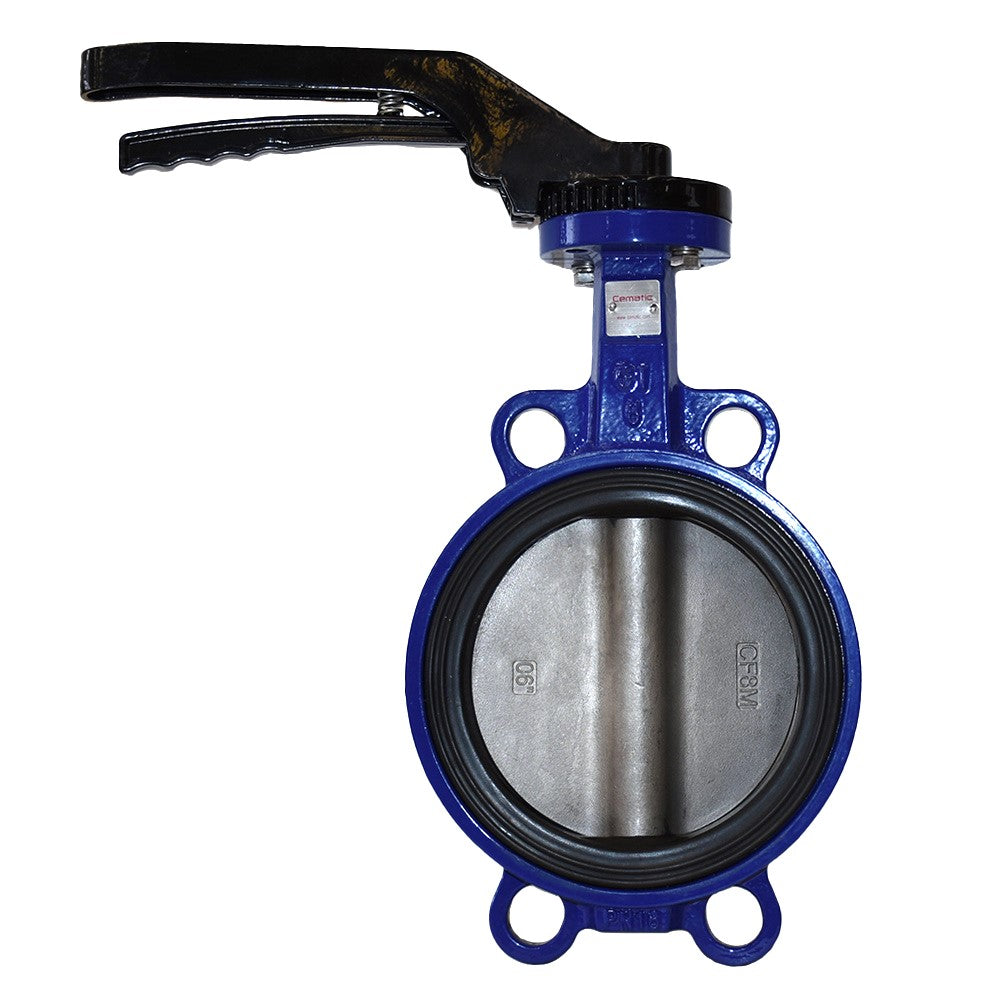
VITON Series 200 Seat Wafer Butterfly Valve
Pickup availability could not be loaded
Series 200 Wafer Butterfly Valve — GG25 Body, CF8M SS316 Disc, Replaceable Viton Seat, up to 200 °C
The Series 200 wafer butterfly valve is the most chemically and thermally resistant version of Cematic's iron butterfly valve family. Its combination of a GG25 cast iron body, CF8M (SS316) disc — full stainless steel, not coated — and replaceable Viton seat covers services where a standard butterfly valve with EPDM or NBR seat is insufficient: aggressive chemicals, hydrocarbons, organic solvents, and process fluids at temperatures up to 200 °C where EPDM would already have deteriorated. The five PTFE bushings on the stem eliminate metal-to-body friction on the stem, reducing operating torque and extending stem life in continuous service.
Series 200 vs. Standard Butterfly Valve — When to Specify Series 200
| Criterion | Series 200 ← This Product | Standard EPDM/NBR Butterfly Valve |
|---|---|---|
| Maximum Temperature | ✅ 200 °C — Viton resists | 120–150 °C — EPDM/NBR deteriorates |
| Maximum Pressure | ✅ 230 psi (15.8 bar) | Standard PN10/PN16 |
| Disc Material | ✅ CF8M (SS316) — full stainless steel | SS304, coated iron, or SS316 depending on version |
| Seat | ✅ Replaceable Viton — hydrocarbons, chemicals, high temperatures | EPDM — water, aqueous fluids, low-temperature steam |
| Stem Bushings | ✅ 5 PTFE bushings — minimal friction | Standard metallic bushings |
| Hydrocarbon Compatibility | ✅ Yes — Viton resists fuels, oils, and derivatives | ❌ EPDM swells with hydrocarbons |
| Organic Solvent Compatibility | ✅ Moderate — check specific fluid with Viton | ❌ EPDM not compatible with solvents |
| Design Standard | API 609 / ISO 5752 | ISO 5752 |
| Relative Cost | Higher — SS316 disc + Viton + PTFE bushings | ✅ Lower — for standard aqueous fluids |
The CF8M (SS316) Disc — A Technical Differentiator of the Series 200
The disc is the only component of the butterfly valve in permanent contact with the fluid in the open position — its material defines the corrosion and erosion resistance of the assembly. In the Series 200:
- CF8M — Cast equivalent of SS316: With 18% Cr, 8–12% Ni, and 2–3% Mo, CF8M resists corrosion from diluted acids, moderate alkalis, seawater, chlorides at room temperature, and most industrial process chemicals. Molybdenum is the element that differentiates SS316 from SS304 in resistance to chlorides and crevice corrosion.
- Solid disc without coating: CF8M is the material of the entire disc — it is not an iron disc with SS316 coating that can delaminate or have pores. Corrosion resistance is uniform throughout the disc section.
- Greater erosion resistance: CF8M has greater hardness than SS304 and significantly greater than coated iron — in fluids with fine suspended particles or high-velocity flows, the CF8M disc lasts longer than softer alternatives.
Replaceable Viton Seat — Chemical Resistance and Ease of Maintenance
The Viton (FKM) seat is field-replaceable — the worn seat can be removed and a new one installed without replacing the entire valve. Viton's chemical compatibility covers services where EPDM cannot be used:
- ✅ Hydrocarbons: Fuels, mineral oils, vegetable oils, gasoline, diesel, LPG — EPDM swells irreversibly with hydrocarbons in weeks.
- ✅ Low-concentration organic solvents: Alcohols, low-concentration ketones, esters — check specific concentration and temperature.
- ✅ High temperature up to 200 °C: Process steam, thermal oils, hot fluids where EPDM fails above 120–150 °C.
- ✅ Diluted acids at moderate temperature: H₂SO₄ up to 20%, HCl up to 10%, HNO₃ up to 15%.
- ✅ Moderate alkalis: NaOH up to 30%.
- ✅ Petrochemical process fluids: Process streams with traces of hydrocarbons and chemicals.
- ⚠️ Concentrated ketones (MEK, acetone): not compatible with Viton.
- ⚠️ Concentrated acids above 30%: use anti-corrosion butterfly valve with PTFE liner.
PTFE Stem Bushings — Friction and Wear Reduction
The technical data sheet documents 5 PTFE bushings on the stem — a constructive detail that differentiates the Series 200 from standard butterfly valves with metallic bushings:
- Reduced operating torque: PTFE has a friction coefficient of ~0.05 — one of the lowest of any solid material. PTFE bushings reduce the actual operating torque compared to metallic bushings, allowing the use of smaller actuators or reducing operator effort in manual operation.
- No lubrication required: PTFE bushings are self-lubricating — they do not require grease or periodic lubrication maintenance for the stem.
- Chemical resistance of the stem: PTFE bushings isolate the SS420 stem from the fluid in the seal area — further protecting against corrosion in chemically active fluids.
Construction Materials
| No. | Component | Material |
|---|---|---|
| 1 | Body | Cast iron GG25 |
| 2 | Disc | CF8M (SS316) — cast equivalent of 316 stainless steel |
| 3 | Stem | SS420 — martensitic stainless steel |
| 4 | Seat | Viton (FKM) — field replaceable |
| 5 | Stem Bushings | PTFE — 5 bushings, self-lubricating |
Technical Specifications with Torque Chart
- Type: Wafer butterfly — between PN10/PN16 flanges
- Design Standard: API 609 / ISO 5752
- Face-to-face: EN 558-1
- Actuator Mounting: ISO 5211
- Inspection and Testing: ISO 5208 / API 598
- Body Material: Cast iron GG25
- Disc: CF8M (SS316)
- Seat: Replaceable Viton (FKM)
- Stem: SS420 with 5 PTFE bushings
- Flange: PN10/PN16
- Working Pressure: Max. 230 psi (15.8 bar)
- Working Temperature: -20 °C to +200 °C
Torque Chart by Diameter — Actuator Selection
The torque of the Series 200 is higher than standard butterfly valves due to the higher friction coefficient of Viton compared to EPDM — always check with a minimum safety factor of 1.25×:
| Diameter | Maximum Torque (Nm) | ISO 5211 Mounting |
|---|---|---|
| 2" (DN50) | 12.5 Nm | F05 |
| 2½" (DN65) | 16.5 Nm | F05 |
| 3" (DN80) | 24 Nm | F05 |
| 4" (DN100) | 41 Nm | F07 |
| 5" (DN125) | 56 Nm | F07 |
| 6" (DN150) | 95 Nm | F07 |
| 8" (DN200) | 185 Nm | F10 |
| 10" (DN250) | 290 Nm | F10 |
| 12" (DN300) | 340 Nm | F10 |
Main Applications
- Chemical industry — aggressive chemicals at elevated temperatures: Isolation of lines for diluted acids, alkalis, low-concentration organic solvents, and chemical process fluids at temperatures of 100–200 °C where EPDM seated butterfly valves are no longer viable. The CF8M disc resists the corrosivity of the fluid, and the Viton seat maintains the seal at these temperatures.
- Petrochemical industry — hydrocarbons: Isolation of transport lines for fuels, oils, LPG, and petroleum derivatives. Viton is the petrochemical industry's standard elastomer for valve seats in hydrocarbon service — EPDM is not a viable alternative in these fluids.
- High-temperature thermal oils: Distribution of thermal oil (Therminol, Dowtherm) at 150–200 °C in industrial heating systems. Viton resists thermal oil at these temperatures, and the CF8M disc does not release metallic ions into the process oil.
- Pulp and paper industry — bleaching chemicals: Lines for NaOH, diluted H₂SO₄, hypochlorite, and other chemicals in the kraft and bleaching process. The SS316 disc and Viton seat cover the chemical resistance of the main reagents in the papermaking process.
- Energy industry — hot process fluids: Cooling systems with organic fluids, handling of water treatment chemicals in thermoelectric and nuclear plants, and distribution of high-temperature process fluids where EPDM is insufficient.
- Textile and dyeing industry: Control of dyeing fluids, chemical auxiliaries, and textile finishing solutions. Viton resists the wide range of solvents and organic chemicals used in dyeing processes — a service where EPDM fails rapidly.
- Process steam systems up to 200 °C: Isolation of process steam lines in industrial facilities where the temperature exceeds the limit of the EPDM seat. Viton maintains its shape and sealing force up to 200 °C in continuous service.
For iron butterfly valves with EPDM seats for standard aqueous fluids, see iron butterfly valve with EPDM/NBR seat →
For more corrosive fluids exceeding the resistance of GG25, see SS316 stainless steel butterfly valve →