
8Products
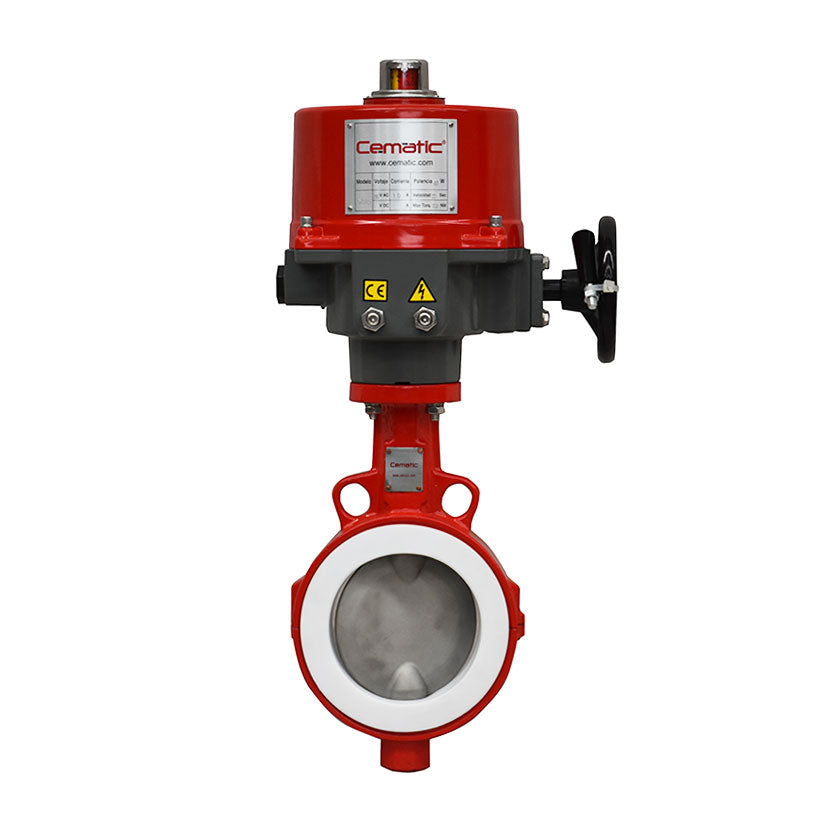

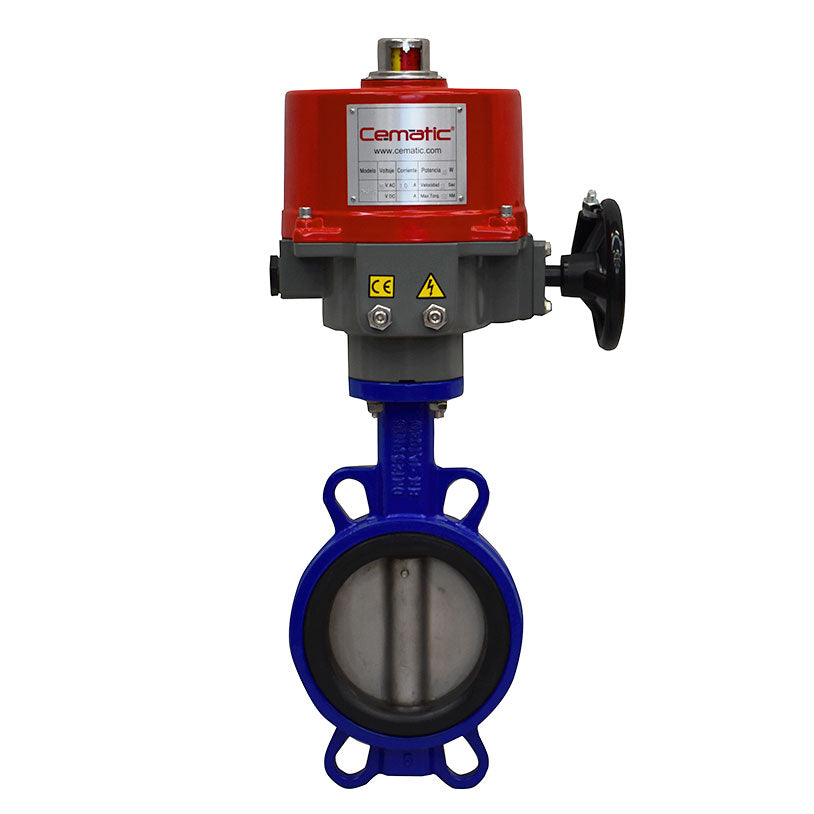


Butterfly Valve with Electric Actuator — Pneumatic-Free Automation for ON/OFF and Modulating Control
The butterfly valve with electric actuator solves the main bottleneck of pneumatic automation: the need for a compressed air network at each control point. Where there is no compressed air piping, where the cost of running it is prohibitive, or where direct digital integration with the control system is a priority, the electric actuator is the technically and economically correct answer. It operates with the electrical supply already available in any industrial facility, connects directly to PLC or DCS outputs, and provides real-time position feedback without additional accessories.
At Cematic, we supply butterfly valves with electric actuators as complete assemblies, assembled and tested in our workshop in Mexico City. Each package includes the valve selected for your fluid, the actuator correctly sized for the required torque, and the appropriate control signal configuration for your system: ON/OFF with digital signal, modulating with 4–20 mA or 0–10 V signal, or with Modbus RTU communication protocol for advanced integration.
Electric Actuator vs. Pneumatic Actuator — When to choose electric?
Both operate the same quarter-turn valve, but their characteristics make them ideal for different installation conditions. There is no universal answer — the correct choice depends on the available infrastructure and process requirements:
| Criterion | Electric Actuator | Pneumatic Actuator |
|---|---|---|
| Required energy source | ✅ Only electrical wiring | Compressed air network 4–8 bar |
| Operating speed | Moderate — 5 to 60 seconds depending on size | ✅ High — 1 to 5 seconds |
| Modulating control 4–20 mA | ✅ Native in most models | Requires additional positioner |
| Digital communication | ✅ Native Modbus RTU, PROFIBUS, BACnet | Requires positioner with HART/Profibus |
| Exact position indication | ✅ 4–20 mA feedback signal included | Only with additional transmitter |
| Last position memory | ✅ Fail-last standard (no spring) | Only with double acting |
| Installation in remote areas | ✅ Only cable — no air piping | Requires pneumatic piping to the point |
| Cost in frequent cycles | Motor can overheat in very fast cycles | ✅ Millions of cycles without degradation |
| Intrinsically safe ATEX zones | ATEX version available (higher cost) | ✅ No electrical components in the valve |
| Integration with BMS / SCADA buildings | ✅ Native BACnet, Modbus TCP/IP | Requires additional I/O |
Choose an electric actuator when: There is no compressed air network available, the process requires precise modulating control without an additional positioner, you need direct digital communication (Modbus, BACnet), the cycling frequency is less than 20 operations per hour, or the installation is in a building or area without pneumatic infrastructure.
Choose a pneumatic actuator when: A compressed air network already exists, response speed is critical (cycles in seconds), the frequency is very high (hundreds of cycles per hour), or the area is ATEX where the pneumatic actuator is intrinsically safer and more economical.
Electric actuator operating modes
ON/OFF Control (Full Open/Close)
The simplest mode. The valve operates only between two positions: 0° (fully closed) and 90° (fully open). The actuator receives a digital signal from the PLC — dry contact, 24 VDC or 110/220 VAC — and moves the valve to the corresponding position. There are no intermediate positions. It is the most reliable mode, requiring the least sophisticated actuator and having the lowest cost. Ideal for batch open/close sequences, section isolation valves, and any application where only "pass" or "no pass" of fluid is needed.
- Input signal: dry contact, 24 VDC, 110 VAC or 220 VAC depending on model
- Feedback: 2 integrated limit switches (open/closed)
- Safety torque: the motor automatically stops when reaching the mechanical open and close stops
Modulating Control with 4–20 mA / 0–10 V Signal
The actuator positions the butterfly disc at any angle between 0° and 90° proportionally to the input signal from the controller. At 4 mA (or 0 V) the valve is closed; at 20 mA (or 10 V) it is fully open; at 12 mA (or 5 V) it is 50% open. This mode converts the butterfly valve into a flow, pressure, or temperature control element within a PID loop. The position feedback signal (4–20 mA output) confirms the actual valve position to the controller in real time.
- Input signal: 4–20 mA (2 wires) or 0–10 V (3 wires) depending on model
- Position feedback: 4–20 mA output signal proportional to position
- Positioning accuracy: ±1–2% of nominal range
- Hysteresis: ≤ 1%
- Travel time (0% to 100%): adjustable — typically 15 to 60 seconds depending on size
Control with Digital Protocol — Modbus RTU / BACnet / PROFIBUS
Advanced electric actuators integrate industrial communication protocols that allow complete control and monitoring of the valve from the control system without additional analog signal wiring. Via Modbus RTU (RS-485), the control system can:
- Send the position setpoint with 0.1% resolution
- Read the actual valve position in real time
- Read operating torque and detect obstructions
- Read accumulated cycles and motor temperature
- Configure travel limits, speed, and response parameters
- Receive fault alarms (overheating, position fault, signal loss)
BACnet MS/TP is available in specific models for integration with Building Management Systems (BMS) in HVAC, hot/cold water plants, and climate control in smart buildings.
Fail-Safe Modes
Unlike the pneumatic actuator —where the spring guarantees the fail position passively— the electric actuator requires specific design for each fail-safe mode:
- Fail-Last (standard): In the event of a power outage, the valve maintains its last position. The self-locking mechanism of the gear reducer immobilizes the disc without energy consumption. This is the most common and economical mode — suitable when the last position is acceptable as a safe state.
- Fail-Open or Fail-Close with battery backup: A lithium battery or integrated capacitors in the actuator maintain enough energy to move the valve to the predefined fail-safe position in the event of a power outage. The actuator detects power loss and performs the emergency movement in less than 5 seconds before exhausting the energy reserve.
- Fail-Safe with mechanical spring (Spring Return): Available in specific models. Combines the electric motor with a return spring that moves the valve to the safe position upon power loss, without relying on a battery. Higher reliability for SIL applications where the safety function cannot depend on batteries.
Electric actuator technical specifications
- Power supply: 24 VDC, 110 VAC or 220 VAC / 50–60 Hz depending on model
- Available torque: 5 Nm to 3,000+ Nm depending on actuator size
- IP protection: IP67 standard for outdoor use and humid environments; IP68 available
- Ambient temperature: -20 °C to +70 °C standard; -40 °C to +70 °C in low-temperature versions
- Motor temperature: Integrated thermal protection — automatic cut-off in case of overheating
- Valve interface: ISO 5211 — compatible with butterfly valves from all manufacturers that meet the standard
- Travel time 0°–90°: 15 s, 30 s, 60 s, 90 s or 120 s depending on model and size — adjustable in some models
- Service class: S2 (intermittent service) — the electric actuator is not suitable for continuous high-frequency open/close cycles
- Certifications: CE; ATEX Ex II 2G versions available for hazardous areas
- Display and local configuration: LCD screen with position indication, menu for parameter configuration without a laptop
Available butterfly valve materials
- Cast Iron / Carbon Steel — EPDM or NBR Seat: For potable water, process water, HVAC, heating systems, and general non-corrosive services. The most economical combination. Available DN50 to DN600.
- Stainless Steel 316 — EPDM, NBR or PTFE Seat: For food, pharmaceutical, moderate chemical industries, and fluids with hygiene or corrosion resistance requirements. DN50 to DN300.
- Corrosion Resistant with PTFE Liner: PTFE-lined interior for moderately corrosive fluids in chemical and water treatment industries. DN50 to DN200.
- High Performance (Double Eccentricity): For high pressure, high temperatures, and fluids with greater differential pressure. Metal or reinforced PTFE seat. DN50 to DN400.
- Hygienic Sanitary: Polished SS316L Ra ≤ 0.8 µm for food, beverage, and pharmaceutical industries. DN50 to DN200.
Main industries and applications
- HVAC and building management: The most frequent application of electric actuators with BACnet or Modbus communication. Zone valves in chilled water and hot water systems, flow control in fan coils and air handling units. Direct integration with BMS without pneumatic infrastructure makes the electric actuator the absolute standard in this sector.
- Potable and wastewater treatment: Remote control of valves in treatment plants, pumping stations, and distribution networks where there is no compressed air supply. 4–20 mA signal for proportional reagent dosing or Modbus for integration with remote operation SCADA.
- Food and pharmaceutical industry: Filling and emptying sequences controlled by recipe from MES or PLC system. The electric actuator allows direct integration with recipe controllers (batch control) without pneumatic infrastructure in clean areas where the air compressor can be a source of contamination.
- Chemical industry in facilities without an air network: Small and medium-sized plants, production laboratories, and pilot units where installing an air compressor and its distribution network is not economically justifiable. The electric actuator allows automating valves with only existing electrical wiring.
- Renewable energy and solar plants: Valve control in panel cooling systems, hot water cycles in thermal solar plants, and energy management systems where Modbus integration with the plant controller is a priority.
- Precision agriculture and technified irrigation: Automation of irrigation sections without air compressors. Low-consumption (24 VDC) electric actuators can operate with solar panels, making automation possible in locations without access to conventional electricity grids.
- Mining in remote locations: Control valves in water distribution systems and reagent dosing where the only available infrastructure is low-voltage electrical wiring from local generators.
Specific applications where the electric actuator is superior to pneumatic
- Proportional temperature control in heat exchangers: The controller's PID loop continuously adjusts the butterfly valve position using a 4–20 mA signal. The electric actuator responds directly without an additional positioner, simplifying installation and reducing failure points.
- Hydraulic balancing valves in distribution networks: Precise positioning at a fixed angle determined by hydraulic calculation. Position memory (fail-last) ensures that in the event of a power outage, the valve maintains system balance until power is restored.
- Integration with agricultural irrigation controllers: Modern irrigation controllers have 24 VDC digital outputs or dry contact relays directly compatible with ON/OFF electric actuators — without signal converters or additional infrastructure.
- Remote control systems via SCADA in water plants: The Modbus RTU protocol of the electric actuator is native to all market SCADA systems, allowing monitoring and control of dozens of valves from a central control room with RS-485 daisy chain wiring.
Why choose the Cematic butterfly valve with electric actuator package?
At Cematic, we deliver the complete assembly: valve selected for your fluid and pressure, actuator sized with verified torque safety factor, configured for your control signal (ON/OFF, 4–20 mA or Modbus), and workshop tested before shipping. You receive an assembly ready to install and connect — without the need to verify interface compatibility, calculate torque, find adapters, or configure actuator parameters in the field.
- ✅ Technical selection with verified torque calculation
- ✅ Control signal configuration (ON/OFF / 4–20 mA / Modbus) before shipping
- ✅ Full functional testing — opening, closing, position feedback
- ✅ Advice for integration with your PLC, BMS or control system
- ✅ Stock available in Mexico City for the highest turnover models
- ✅ Same-business-day technical quote — nationwide shipping
Contact us via WhatsApp or at ventas@cematic.com.