
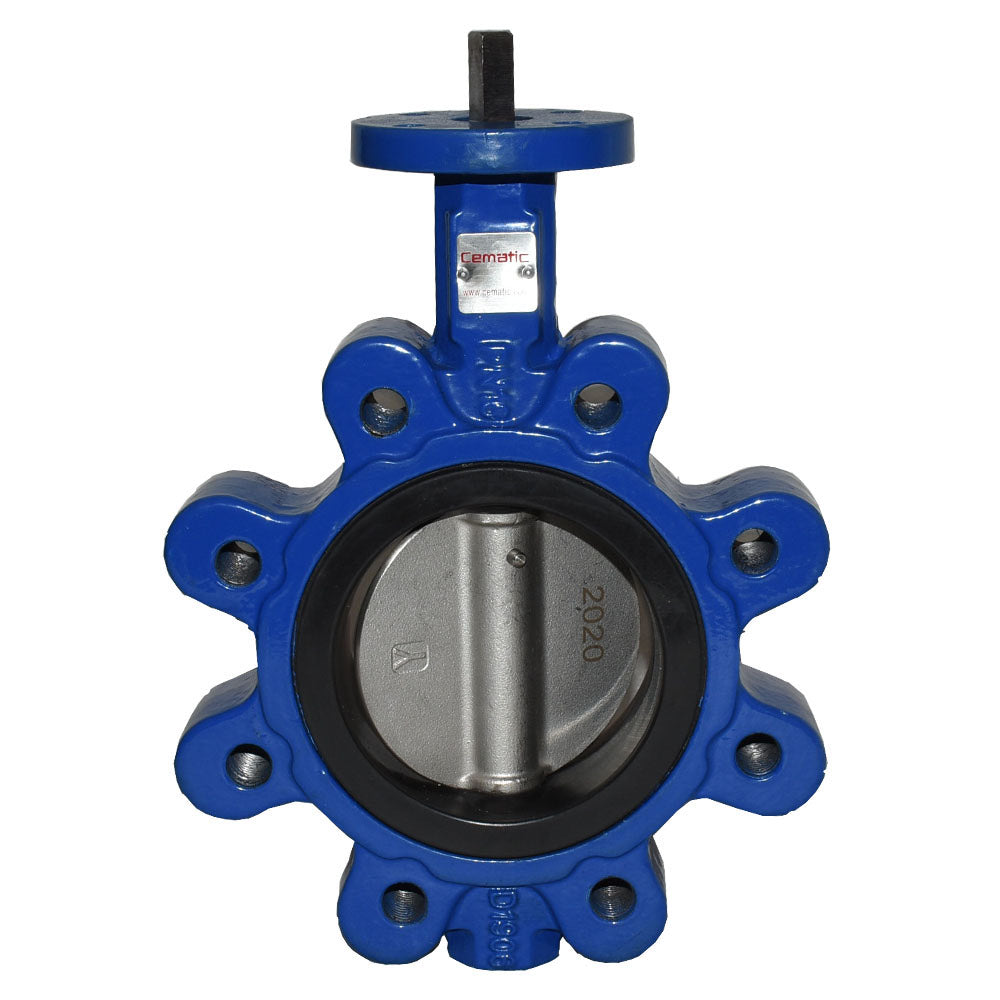
ANSI 150 Lug Type Butterfly Valve
Pickup availability could not be loaded
Lug Type Butterfly Valve ANSI 150 — Ductile Iron Body, SS304 Disc, EPDM Seat
The Lug type butterfly valve ANSI 150 is the threaded lug version of the iron butterfly valve — the correct specification when the installation requires dead-end service or the ability to disconnect one side of the pipe without losing pressure on the other. Unlike the wafer butterfly valve, which needs both flanges to stay in position, the Lug butterfly valve has threaded holes in the body that allow it to be bolted directly to each flange independently. The ductile iron body — mechanically stronger than conventional gray iron — provides greater impact resistance and ductility. The SS304 disc and EPDM seat cover potable water, process water, HVAC, and general industrial services fluids up to 110 °C.
Lug vs. Wafer Type — the difference that determines when to use each
This is the most frequent question when specifying an iron butterfly valve. The answer depends on whether the process requires dead-end service:
| Criterion | Lug Butterfly Valve ← This product | Wafer Butterfly Valve |
|---|---|---|
| Body holes | ✅ Threaded — bolts directly to each flange | Through-holes — requires bolts that pass through both flanges |
| Dead-end service | ✅ Yes — can withstand pressure with only one flange connected | ❌ No — requires both flanges to withstand pressure |
| Disconnection of one side without emptying the system | ✅ Yes — remove bolts from downstream flange, upstream remains pressurized | ❌ No — valve becomes loose when bolts are removed |
| Isolation of downstream equipment | ✅ First choice — close valve, remove downstream flange, service equipment | Requires additional valve or emptying the entire line |
| Valve replacement | ✅ Without emptying the upstream line — just close and remove the downstream flange | Requires closing and emptying both sides |
| End-of-line | ✅ Suitable — withstands pressure with only the upstream flange | ❌ Not suitable — without downstream flange, the valve is not secured |
| Relative cost | Higher — more complex body with threaded holes | ✅ Lower — no threaded holes |
| Axial space | Same as wafer — same face-to-face | ✅ Same axial space |
Ductile iron vs. gray iron — why it matters in Lug applications
The ductile iron (GGG40 or similar) body has superior mechanical properties to the gray iron GG25 of standard wafer butterfly valves:
- Higher tensile strength: Ductile iron has a tensile strength of 400–500 MPa vs. 200–250 MPa for gray iron — greater structural resistance to withstand the stresses of threaded holes when only one flange is connected in dead-end service.
- Greater ductility: Ductile iron does not fail in a brittle manner like gray iron when subjected to impacts or overloads — it absorbs impact energy by deforming slightly before fracturing. In industrial installations where the valve may receive impacts from tools or equipment, this ductility provides greater safety.
- Higher fatigue resistance: The threaded holes of the Lug body are stress concentrators. Ductile iron better withstands pressure loading and unloading cycles at these points — preventing the initiation of fatigue cracks that could occur in gray iron.
Construction Materials
| Component | Material |
|---|---|
| Body | Ductile Iron — higher mechanical strength than gray iron |
| Disc | Stainless Steel SS304 |
| Seat | EPDM |
| Actuator mounting pad | ISO 5211 |
Technical Specifications
- Type: Lug type butterfly valve — threaded holes for dead-end service
- Actuator mounting pad: ISO 5211
- Connection: ANSI 150 Flanges
- Body material: Ductile iron
- Disc: Stainless steel SS304
- Seat: EPDM
- Working pressure: 230 psi (PN16) at ambient temperature
- Working temperature: -20 °C to +110 °C
- Pneumatic actuator: Single or double acting
- Electric actuator: ON/OFF or modulating
Fluid compatibility — ductile iron + SS304 + EPDM
- ✅ Potable water and municipal water
- ✅ Clean industrial process water
- ✅ HVAC water — chilled water and hot water up to 110 °C
- ✅ Chlorinated water up to 5 ppm
- ✅ Wastewater with fine non-corrosive solids
- ✅ Compressed air and non-corrosive gases
- ✅ Agricultural irrigation water
- ⚠️ Water with high chlorides: SS304 disc may suffer pitting — use SS316 disc
- ⚠️ Temperature above 110 °C: EPDM deteriorates — use Viton seat
- ❌ Hydrocarbons: EPDM not compatible — use NBR or Viton seat
- ❌ Aggressive acids and alkalis: ductile iron body not resistant — use SS316
Automation — ISO 5211
The ISO 5211 mounting pad allows the Lug butterfly valve to be automated with the same pneumatic and electric actuators as the wafer version. The Lug type does not affect actuator selection — the operating torque is identical to that of the wafer butterfly valve of the same diameter and seat.
- Single-acting NC pneumatic actuator: For installations where automatic safety shutdown in case of air failure is required — process water, fire protection systems, and general industrial services. NC ensures shutdown without reliance on the control signal. See butterfly valves with pneumatic actuator →
- ON/OFF or modulating electric actuator: For installations without a compressed air network or with control from BMS or PLC. See butterfly valves with electric actuator →
Main Applications — when Lug is mandatory
- Equipment isolation in water distribution systems: The most frequent application of the Lug butterfly valve in Mexico. In water treatment plants, municipal distribution systems, and industrial networks, the Lug butterfly valve allows a downstream pump, filter, or equipment to be isolated for maintenance without needing to shut down and empty the entire upstream line — reducing downtime and impact on service.
- End-of-line in distribution: At points where the pipeline ends — outlet of a manifold, connection to equipment without a return flange — the Lug butterfly valve withstands pressure with only the upstream flange connected. A wafer butterfly valve at this point would be unsecured on the opposite side and could not be used.
- HVAC — water distribution systems in buildings: Isolation of chilled water and hot water circuits in HVAC systems for hospitals, hotels, and commercial buildings where each zone or equipment must be able to be isolated independently for maintenance without affecting the rest of the system. The Lug butterfly valve in each branch allows this operation.
- Potable water treatment plants: Isolation of filters, clarifiers, chlorinators, and treatment equipment where maintenance must be able to be performed with the upstream system in operation. Ductile iron resists treated water with residual chlorine, and EPDM is the standard seat for potable water.
- Fire protection systems: Isolation valves for sections in fire water networks where the applicable standard requires the ability to isolate a section of the network without affecting the rest — the Lug butterfly valve provides this capability without additional valves.
- General industry — scheduled maintenance points: In any industrial installation where equipment maintenance is planned and sections of pipe need to be isolated independently without a general plant shutdown, the Lug butterfly valve at key points in the distribution network is the correct specification.
For the wafer version without dead-end service and lower cost, see wafer iron butterfly valve with SS316 disc →
For the Lug version in stainless steel for corrosive fluids, see stainless steel butterfly valve →