
Inclined Seat Valve Clamp SS316 | Normally Closed
Pickup availability could not be loaded
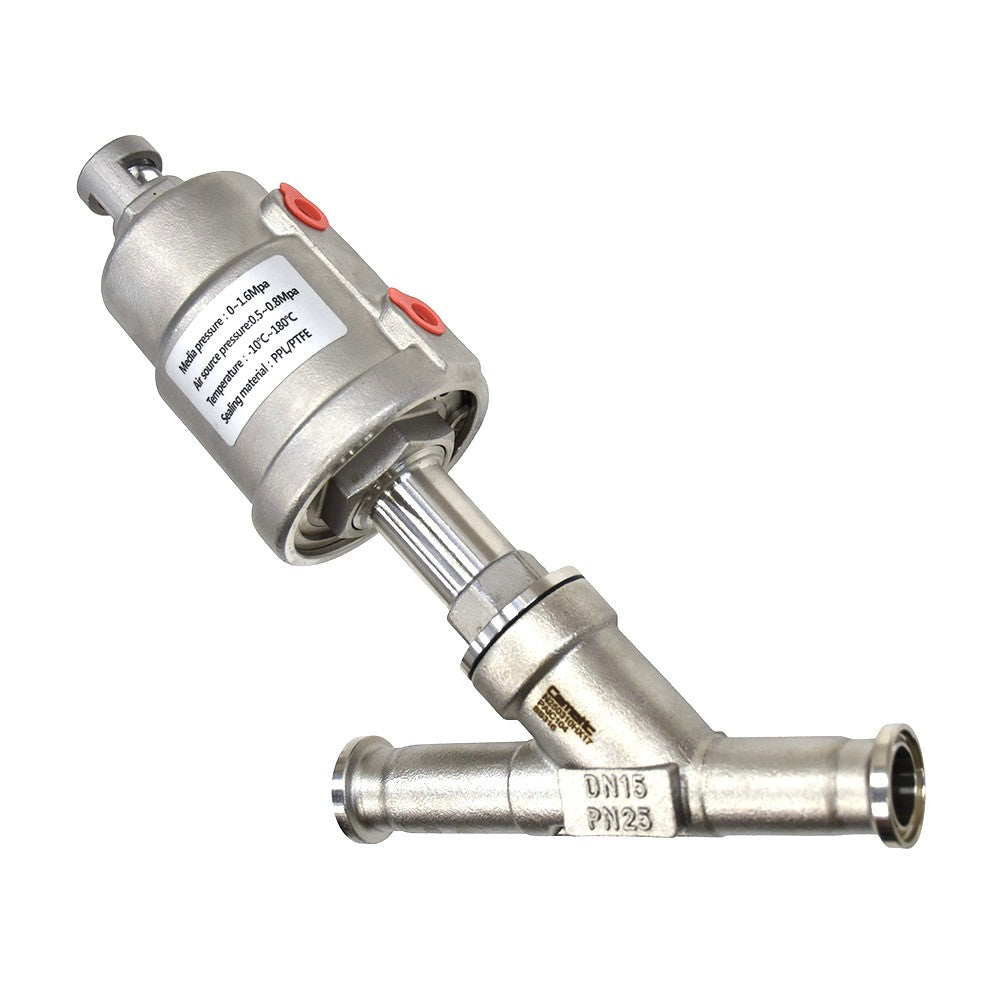
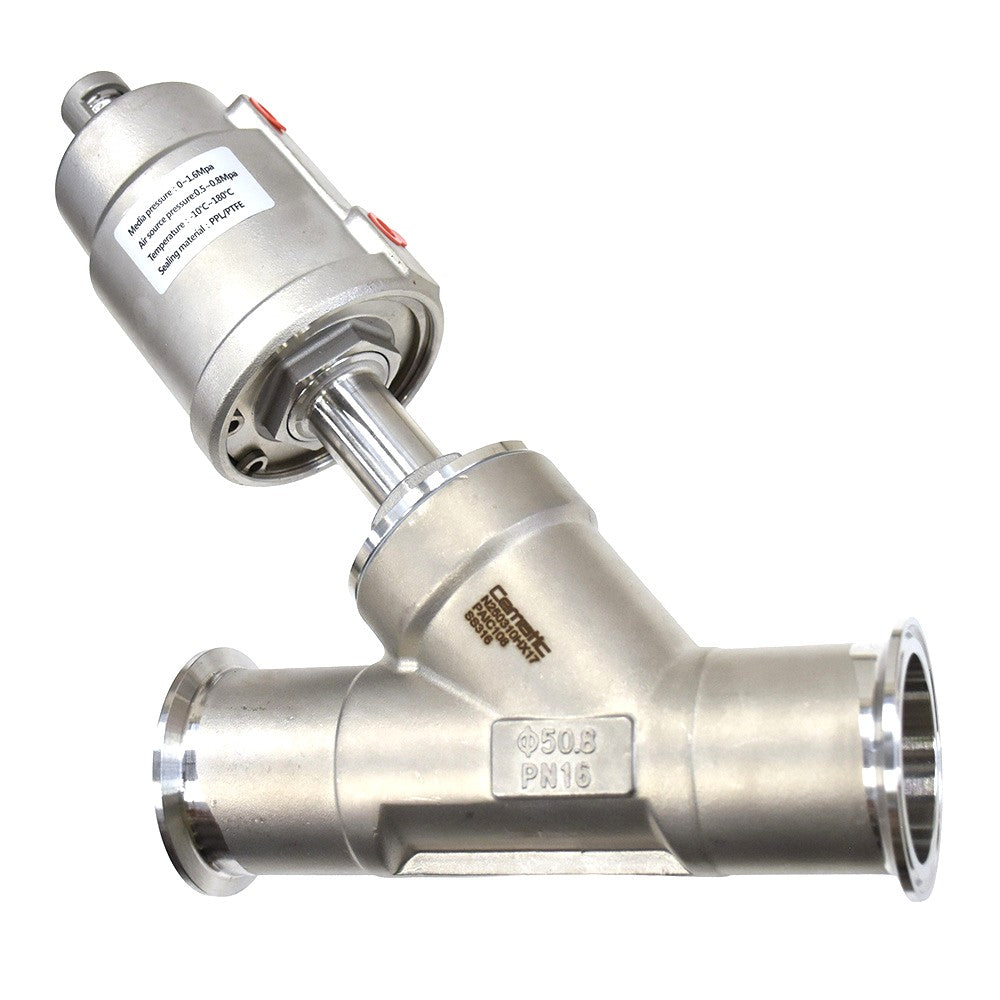
Clamp Angle Seat Valve SS316 — Normally Closed
Cematic's Clamp Angle Seat Valve SS316 precisely and reliably controls fluid flow in industrial and general service lines. Its angle seat design, unlike ball or butterfly valves, reduces pressure losses and improves flow efficiency.
This results in less wear on the obturator and extends its service life. Additionally, its 316 stainless steel body resists aggressive environments without degrading, making it suitable for a wide range of industrial and process fluids.
Its normally closed pneumatic operation also ensures automatic fluid shut-off in the event of air supply or control system failure. Consequently, it is the standard configuration in lines where the safe state of the process requires the fluid to be cut off in the event of any unplanned failure.
Operating Principle — Clamp Angle Seat Valve
The valve's obturator moves linearly towards the angled seat to close the fluid passage. Unlike a ball valve, the linear obturator acts perpendicularly to the flow.
This ensures a tight and progressive seal, making it especially suitable for viscous fluids or those with suspended particles. Furthermore, opening and closing are smooth and controlled, which prevents product shearing.
Its single-acting pneumatic actuator moves the obturator to the open position when compressed air is received. When the air supply is cut off, the internal spring automatically returns the obturator to the closed position.
Thus, the normally closed (NC) configuration guarantees safety shut-off in the event of any pneumatic failure.
Why Angle Seat vs. Ball or Butterfly Valve
The angle seat geometry offers specific technical advantages that differentiate it from other valve types:
- Lower pressure loss: The angled seat creates a more fluid flow path than the straight seat of a conventional globe valve, thereby reducing pressure losses in the line and improving the system's energy efficiency.
- Handling viscous fluids: The linear obturator is more suitable than a ball or disc for viscous fluids. It also does not generate shearing or product retention in internal cavities. Furthermore, progressive closing prevents water hammer in pressurized lines.
- Less obturator wear: The angled design distributes closing forces more evenly than the straight seat. This results in less seal wear and a longer obturator lifespan.
- Quick disassembly: The clamp connection allows the valve to be installed and removed without special tools. Consequently, it reduces maintenance times compared to flanged or threaded valves.
Application in Secondary and General Services
This clamp angle seat valve SS316 is designed for general and secondary industrial services where a stainless steel body and clamp connection are required, without the certified finish requirements of Ra ≤ 0.8 µm for high-purity hygienic valves. Therefore, it is the correct choice in the following services:
- Process water, hot water, and service steam — SS316 resists corrosion from process water and steam; additionally, the maximum temperature of 180 °C covers most industrial steam services.
- CIP solutions in cleaning circuits — in the distribution area of CIP agents where the valve is not in direct contact with the final product, SS316 resists caustic soda, nitric acid, and peracetic acid.
- Utilities in food and pharmaceutical plants — service water, heating steam, and cleaning solutions in utility lines where Ra ≤ 0.8 µm surface certification is not required.
- Moderately aggressive industrial fluids — diluted acids, bases, and saline solutions compatible with SS316; however, for extremely aggressive fluids, verify compatibility with Cematic's technical team.
- Steam and hot water in heating services — up to 180 °C and 1.6 MPa; for direct product contact applications requiring certified hygienic finish, consult other Cematic valve families.
Construction Materials
The body is made of 316 stainless steel (SS316), which is the standard material in services with moderately aggressive fluids, as its molybdenum content offers greater resistance to chlorides and cleaning agents than SS304.
The internal finish is standard machined, which is suitable for general and secondary services where a certified mirror-polished finish is not required. The connection is clamp-type, allowing the valve to be installed and removed without special tools and reducing maintenance times.
Finally, the actuator is single-acting pneumatic, with a return spring for automatic closing in case of air supply failure.
Technical Specifications
| Parameter | Value |
|---|---|
| Valve type | Angle seat |
| Design | 2/2 Way Normally Closed (NC) |
| Actuator | Single-acting pneumatic (spring return) |
| Body material | Stainless steel 316 (SS316) |
| Connection | Clamp |
| Internal finish | Standard polished |
| Working pressure | 0 to 1.6 MPa (0 to 232 psi) |
| Working temperature | -10 °C to 180 °C |
| Air supply pressure | 0.5 to 0.8 MPa (72.5 to 116 psi) |
| Application | General and industrial service |
Applications of the SS316 Clamp Angle Seat Valve
Process Water and Service Steam
The SS316 Clamp Angle Seat Valve is reliable in process water, hot water, and service steam lines up to 180 °C. Its NC pneumatic actuator also ensures automatic closing in the event of any control system failure.
Consequently, maintenance teams rely on its continuous performance without frequent replacements in high-temperature services.
CIP Circuits and Cleaning Agent Distribution
In the distribution of CIP solutions — caustic soda, nitric acid, peracetic acid — this valve also resists the most common agents without deteriorating. For this reason, it is suitable for CIP agent distribution circuits where the valve is not in direct contact with the final product.
Additionally, the clamp connection reduces maintenance times in installations with many control points.
Utilities in Food and Pharmaceutical Plants
In utility lines — heating steam, service water, cleaning solutions — within plants with sanitary standards, SS316 meets material requirements without the need for the Ra ≤ 0.8 µm finish only required for direct product contact.
Consequently, it is the correct choice in secondary services where a stainless steel body and clamp connection are required. Its cost is also lower than that of high-purity hygienic valves.
Moderately Aggressive Industrial Fluids
316 stainless steel also withstands acidic and saline liquids without oxidizing or losing strength. Therefore, this valve lasts longer and reduces maintenance costs compared to valves made of materials with lower chemical resistance.
Consequently, it is the correct choice in process plants where fluids exclude carbon steel or SS304 due to corrosion reasons.
General Chemical Industry
In general chemical plants, the SS316 body and angle seat offer the right combination of chemical resistance, low wear, and safe NC operation. Therefore, it is a suitable technical-economic alternative for this type of service.
Additionally, the maximum pressure of 1.6 MPa covers most working pressures in industrial chemical process systems. Therefore, it is a correct technical-economic alternative to higher-specification valves when the fluid and service allow it.
For the complete range of angle seat valves, see angle and vertical seat valves collection →