
Explosion-Proof Double-Acting Rotary Smart Positioner | 4-20 mA | HART | IP67
Pickup availability could not be loaded
Ex-Proof Double-Acting Rotary Smart Positioner — 4-20 mA and HART Communication, IP67, featuring Real-Time Auto-Tuning for Rotary Actuators
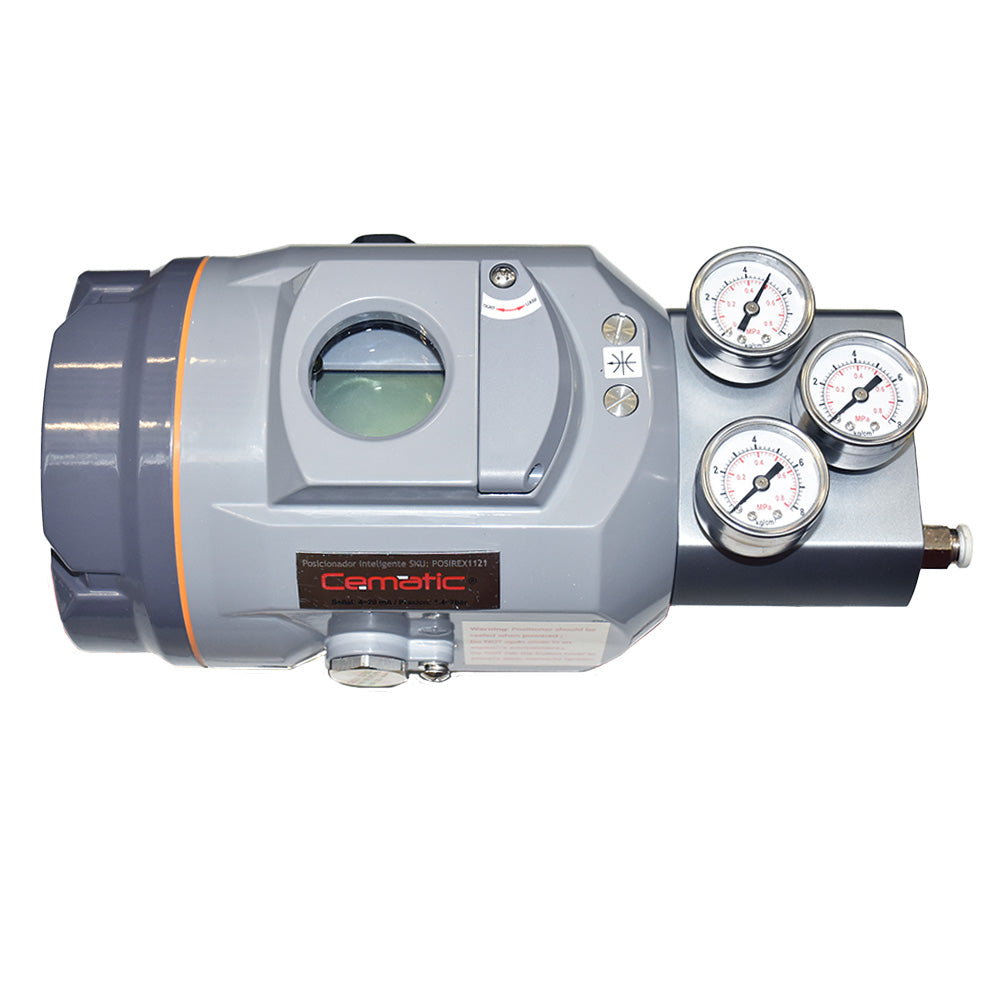
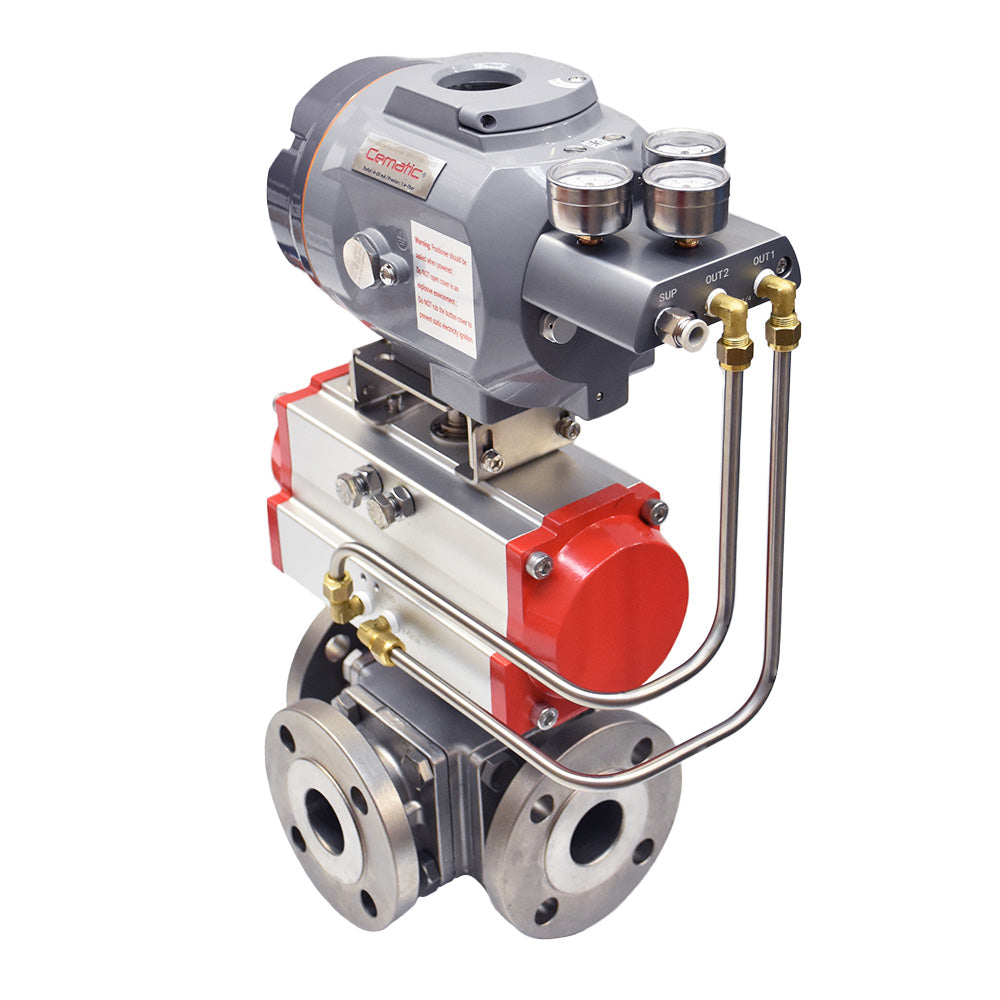
Cematic's Ex-Proof rotary smart positioner is the position control device for valves with rotary pneumatic actuators — ball, butterfly, and trunnion ball valves — in classified industrial areas. It is also the correct positioner for processes requiring remote diagnostics via HART and simultaneous control of both chambers of the rotary actuator.
Unlike conventional electro-pneumatic positioners, this model incorporates digital technology with real-time auto-tuning. It also features HART communication, which enables remote diagnostics of the valve-actuator assembly status from the DCS or control room.
Its Ex-Proof certification also makes it suitable for installation in areas with potentially explosive atmospheres where standard positioners are not permitted. The IP67 protection and aluminum housing also ensure durability in environments with moisture, vapors, or aggressive conditions.
HART and auto-tuning — why the smart positioner outperforms the standard electro-pneumatic in critical processes
The difference between a smart positioner and a standard electro-pneumatic one goes beyond positioning accuracy. The smart positioner reduces maintenance costs through remote diagnostics. The advantages that justify the smart positioner in critical processes are described below:
- Real-time auto-tuning — as it eliminates drift and the need for periodic manual calibration: The positioner continuously adjusts its control parameters according to actual process conditions. Therefore, it does not require periodic manual calibration. Consequently, the valve maintains its positioning accuracy even when process conditions vary.
- HART communication — since it enables remote diagnostics without accessing the valve in the field: The HART protocol transmits diagnostic data from the positioner-actuator-valve assembly to the DCS. Consequently, technical personnel can check the instrument status without visiting the process area. Technical personnel can check the actual position, input signal, and alarm status from the control room, thus reducing inspection visits to the process area.
- 3 pressure indicators included — to check the pressures in both chambers and the supply, thus avoiding the need to carry portable pressure gauges: The indicators allow visual verification of the supply pressures and the pressure in each actuator chamber in the field. They are also useful during commissioning and fault diagnostics. Likewise, they are useful during commissioning and fault diagnostics without the need for portable pressure gauges.
Additional advantages of the smart positioner: reduced air consumption and communication with the DCS
- Reduced air consumption — since auto-tuning minimizes unnecessary position corrections: Conventional positioners make continuous corrections even when the position error is small. The smart positioner also applies algorithms that minimize air consumption in steady state, which reduces the compressor operating cost in systems with many valves.
Ex-Proof — why it is the correct specification in hazardous areas, since the standard positioner is not permitted
The Ex-Proof certification defines that the positioner can be installed in classified industrial areas. It is the only permitted instrument where there is a risk of explosive atmospheres. It is the most important safety requirement for this type of product. A non-certified positioner in a classified area is, therefore, a potential ignition source:
- Areas with flammable gases and vapors — where the standard positioner is not permitted, since it can be an ignition source: In refineries, petrochemical plants, and natural gas plants, process areas are classified. Therefore, the Ex-Proof positioner is the only permitted one in those facilities. The Ex-Proof positioner is the only correct specification in those areas, since the standard positioner could generate a spark that ignites the atmosphere.
Ex-Proof in critical processes where positioner reliability is also a safety requirement
- Critical processes where the control valve cannot stop, since the positioner must be as reliable as the valve: In critical process control valves, the positioner must be as reliable as the valve itself. The robust aluminum construction with IP67 also ensures that the positioner operates without failure even in environments with moisture, vapors, or corrosive agents.
Double-acting — what it means for the positioner and when it is the correct specification according to the actuator
The term "double-acting" in the positioner refers to compatibility with double-acting pneumatic actuators — not to the positioner itself. The implication of this specification is described below. Incorrect selection directly affects the operation of the assembly:
- Compatible with double-acting rotary actuators — since it controls both chambers of the actuator simultaneously: In a double-acting actuator, compressed air activates both opening and closing. The double-acting positioner controls the pressure in both chambers, therefore it is the correct specification for that type of actuator. The available torque is also greater than in single-acting because there is no spring opposing the movement.
- Not compatible with single-acting actuators — for those, a single-acting positioner is required, although the 4-20 mA signal is the same: Single-acting actuators only need pressure control in one chamber. Specifying a double-acting positioner for a single-acting actuator would not utilize the positioner's second air output.
Technical specifications that define the application limits of the Ex-Proof linear smart positioner
| Parameter | Value |
|---|---|
| Positioner type | Smart digital — real-time auto-tuning |
| Compatibility | Double-acting rotary pneumatic actuators |
| Input signal | 4-20 mA |
| Communication | HART |
| Enclosed protection | IP67 |
| Certification | Ex-Proof — for areas with potentially explosive atmospheres |
| Housing material | Corrosion-resistant aluminum |
| Indicators included | 3 pressure indicators (supply + chamber A + chamber B) |
| Calibration | Automatic — digital auto-tuning without periodic manual calibration |
Smart positioner vs. standard electro-pneumatic — comparison table to select the correct one in classified areas
| Criterion | Standard electro-pneumatic positioner | Ex-Proof smart positioner ← This product |
|---|---|---|
| Calibration | ⚠️ Manual — requires periodic adjustment in the field | ✅ Automatic — real-time auto-tuning without intervention |
| Remote diagnostics | ❌ Not available — visual inspection in the field only | ✅ HART — position, pressure, and alarm status data from the DCS |
| Installation in a classified area | ❌ Not permitted — potential ignition source | ✅ Ex-Proof certified — permitted in areas with explosive atmospheres |
| Pressure indicators | ⚠️ Generally not included — installed separately | ✅ 2 included indicators — visual verification without additional instruments |
| Air consumption | ⚠️ Higher — continuous corrections even when the error is small | ✅ Lower — the smart algorithm minimizes corrections in steady state |
| Relative cost | ✅ Lower — for standard applications without a classified area | Higher — justified in classified areas or processes where remote diagnostics reduce maintenance costs |
Main applications of the Ex-Proof linear smart positioner where remote diagnostics are also a requirement
- Control valves in refineries and petrochemical plants where the area is classified: In distillation, cracking, and reforming units, rotary control valves — ball and butterfly — operate in classified areas where the Ex-Proof positioner is the only permitted one. HART communication also allows the positioner to be integrated into the plant's asset management system without additional wiring.
- Natural gas and LPG plants where the presence of hydrocarbons classifies the area: In gas compression and processing stations, the Ex-Proof positioner ensures that the instrument is not an ignition source. Real-time auto-tuning maintains control accuracy even when process conditions vary during the production cycle.
Applications where auto-tuning and HART reduce the maintenance cost of the control system
- Dosing and mixing processes where positioning accuracy impacts product quality: In reagent dosing or fluid mixing systems, the positioning error directly translates to variation in product concentration. Since the smart positioner continuously adjusts its parameters, it keeps the position error within process limits even when stem friction or differential pressure changes.
- Integration into automated control systems where predictive diagnostics are a priority: When the plant operates with predictive maintenance based on positioner data, HART communication transmits the valve signature, cycle histogram, and wear alerts. The maintenance team can therefore plan interventions before the valve fails in process.
- Optimization of air consumption in facilities with many control valves: In plants with dozens of control valves, reducing air consumption per valve has a significant impact on the compressor operating cost. The smart positioner reduces that consumption, therefore improving the energy efficiency of the plant's pneumatic control system.
For the full range of positioners, see positioner collection →