
Normally Closed Piloted Solenoid Valve
Pickup availability could not be loaded
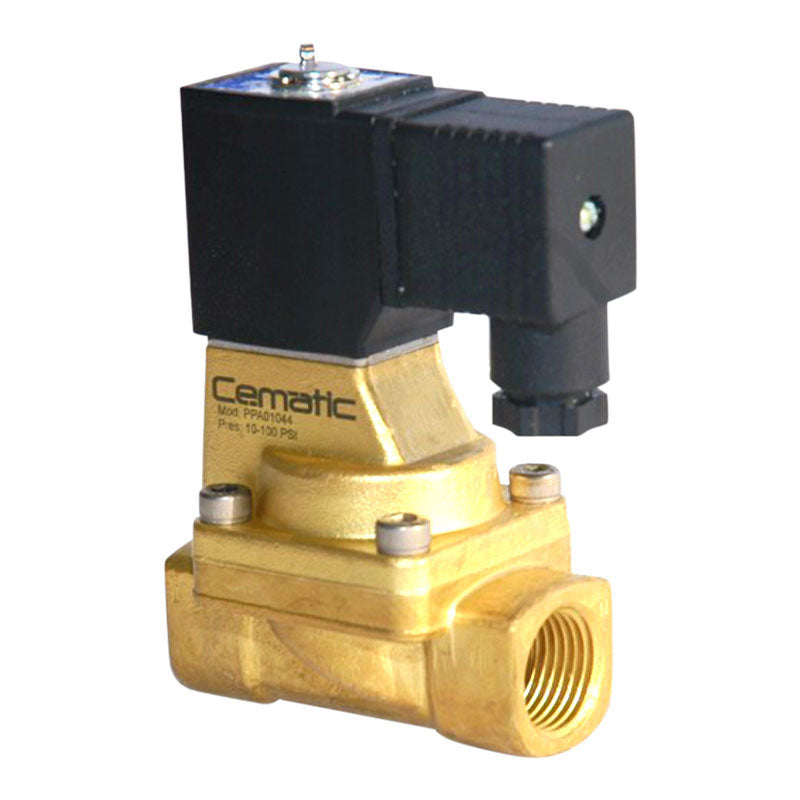
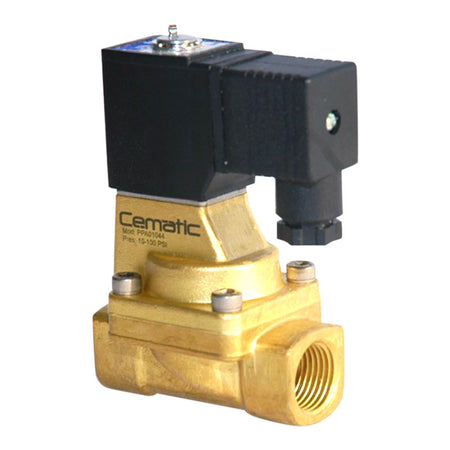
Normally Closed Piloted Solenoid Valve in Brass — NBR, 2/2-Way
Cematic's normally closed piloted solenoid valve in brass is a 2/2-way solenoid valve designed to control high flow rates with low coil power consumption in systems where the safety state in the event of electrical failure is fluid cutoff. Its piloted operation principle uses the fluid's own differential pressure to move the main plunger — the coil only activates a small pilot orifice — which allows it to handle diameters from 1/2" to 1" with coils consuming as little as 12 VA (220 VAC) or 20 W (24 VDC). Therefore, it is the right choice for high-flow systems requiring automatic safety shutoff where direct-acting valves would require high-consumption coils.
The combination of a piloted principle and NC configuration makes it the standard solenoid valve for zone irrigation systems, medium-flow industrial process control, and any application where fluid must be automatically shut off in the event of an electrical failure, with low-power coils for installations with multiple valves active simultaneously.
Operating Principle — Piloted Normally Closed (NC)
In the de-energized state (coil off): the pilot is closed, the pressure in the main plunger's upper chamber equals the inlet pressure, and the spring holds the plunger in the closed position — fluid does not flow. When the coil is energized, the pilot opens, the pressure in the upper chamber drops, and the pressure difference between inlet and outlet moves the main plunger upwards, opening the fluid path. Upon de-energizing, the pilot closes again, and the spring automatically returns the plunger to the closed position.
Critical operating condition: A minimum differential pressure of 0.05 MPa (0.5 bar / 10 psi) between inlet and outlet is required for the piloted mechanism to function correctly and for the valve to open. If the system can start or operate with zero differential pressure, the correct option is the direct-acting NC brass solenoid valve →
Piloted NC vs. Direct-Acting NC — when to choose each
- Direct-acting NC: The coil moves the plunger directly. Works with zero differential pressure — suitable for systems that start without pressure or with variable pressure. However, in larger diameters, it requires higher power coils and bulkier solenoids.
- Piloted NC (this product): The coil activates a pilot that uses the pressure difference to move the main plunger. Consequently, it controls high flow rates with very low power coils (12–25 VA). The necessary condition is a minimum differential pressure of 0.05 MPa at all times of operation.
Therefore, the piloted NC is the correct choice when the system always operates with a differential pressure greater than 0.5 bar, automatic safety shutoff is required, and electrical power consumption of the coils needs to be minimized — especially in installations with many valves active simultaneously.
Construction Materials
- Body: Brass — corrosion resistance for potable water, process water, compressed air, and light hydraulic oils. A cost-effective option for most general industrial applications.
- Plunger and pilot: Stainless steel — resistant to corrosion from process fluid.
- Seat seal: NBR (Nitrile) — compatible with water, compressed air, and mineral hydraulic oils up to 80 °C.
- Coil: Encapsulated, IP65 protection — suitable for humid environments and industrial dust. Low consumption: 20 W at 24 VDC / 25 VA at 110 VAC / 12 VA at 220 VAC.
- Connection: Female NPT thread — industrial standard in Mexico, compatible with steel, copper, and PVC pipes with adapters.
Technical Specifications
| Parameter | Value |
|---|---|
| Valve type | Internally piloted solenoid valve |
| Configuration | 2/2-way Normally Closed (NC) |
| Body material | Brass |
| Seat seal | NBR |
| Connection | Female NPT thread |
| Available diameters | 1/2", 3/4", 1" |
| Minimum working pressure | 0.05 MPa (0.5 bar / 10 psi) — required for piloted opening |
| Maximum working pressure | 1.0 MPa (10 bar / 100 psi) |
| Minimum fluid temperature | -5 °C |
| Maximum fluid temperature | 80 °C |
| Electrical protection | IP65 |
| Voltage / Coil consumption | 24 VDC — 20 W / 110 VAC — 25 VA / 220 VAC — 12 VA |
| Base SKU | PP01042 |
Voltage and Coil Consumption Selection
- 24 VDC — 20 W: Standard in control cabinets with PLC and DC power supply. The most common option in new installations and modern automated systems. Available in 1/2" and 1".
- 110 VAC — 25 VA: For 110 V single-phase circuits available in the field — the most widespread voltage in industry in Mexico. Available in all diameters.
- 220 VAC — 12 VA: The lowest consumption of the three options — an advantage in installations with many valves or with restrictions on the control transformer's capacity. Available in all diameters.
Fluid Compatibility
- ✅ Potable water and process water — up to 1.0 MPa and 80 °C
- ✅ Compressed air — up to 1.0 MPa, pneumatic service and instrumentation
- ✅ Mineral hydraulic oils — up to 1.0 MPa, compatible with NBR seal
- ✅ Cooling and process water — HVAC systems and industrial cooling
- ⚠️ Differential pressure below 0.05 MPa: the piloted valve cannot open — use direct-acting NC brass solenoid valve →
- ⚠️ Fluids with suspended particles: install an upstream in-line filter — the pilot orifice is small and sensitive to solids
- ⚠️ Temperature above 80 °C: the NBR seal degrades — consider an NC solenoid valve with a Viton seal
- ❌ Concentrated acids, chlorinated solvents: use a solenoid valve with a stainless steel body
When to choose this valve vs. other Cematic piloted NC valves
- Piloted NC Brass + NBR (this product): For water, air, and general oils up to 80 °C and up to 1.0 MPa where brass is compatible. Diameters 1/2", 3/4", and 1". The standard, lower-cost option with a piloted principle and safety shutoff.
- Piloted NC SS304 + Viton: For fluids requiring a stainless steel body, temperatures above 80 °C, or greater chemical resistance. See piloted NC stainless steel solenoid valve →
Main Industrial Applications
Technified zone irrigation systems — the most common application
The normally closed piloted solenoid valve in brass is the standard component in drip and sprinkler irrigation systems with zone distribution. Water flows only during the programmed irrigation cycle — when the coil is activated — and automatically shuts off at the end of the cycle or in the event of any electrical failure of the controller. Furthermore, the low coil consumption (12–25 VA) allows multiple valves to be powered from a low-power control transformer, significantly reducing the cost of the electrical installation.
Flow control in medium-flow industrial processes
In manufacturing and processing plants where the required flow rate would exceed the capacity of an equivalent-sized direct-acting solenoid, this piloted NC valve can handle the necessary flow in 1/2" to 1" diameters with very low-consumption coils. Consequently, in installations with 10 or more valves active simultaneously, the reduction in coil power consumption is a significant economic factor.
Liquid dispensers and automatic process equipment
In beverage dispensers, dosing equipment, and packaging lines where the line's differential pressure always exceeds 0.5 bar, this piloted NC solenoid valve integrates ON/OFF fluid control from a PLC with automatic shutoff at the end of each dispensing cycle. Therefore, it ensures that no fluid circulates outside the programmed cycle and eliminates the risk of spillage due to electrical failure.
HVAC systems and zoned hot/cold water control
In air conditioning installations with water distribution where the hydraulic circuit pressure always exceeds the minimum required, this piloted NC valve controls the flow rate of each zone or terminal unit with low electrical consumption. Additionally, the NC shutoff ensures that zones automatically close in the event of any control system failure, preventing thermal energy waste.
Industrial washing equipment and low-temperature CIP
In washing tunnels, parts washers, and clean-in-place (CIP) systems with water temperatures below 80 °C, this piloted NC solenoid valve controls the supply of water and cleaning solutions in programmed cycles, with automatic shutoff at the end of each stage of the washing process.
For the complete range of solenoid valves, see solenoid valve collection →