
12Products




316 Stainless Steel Ball Valves — Full Range in NPT Thread, ANSI Flange, and Clamp for Every Application
The 316 stainless steel ball valve is the isolation device of choice in Mexican industry for ½" to 4" lines where tight shut-off, corrosion resistance, and simple quarter-turn operation are required. Its perforated ball with a central bore—full or reduced port—rotates 90° on two PTFE seats to go from fully open (unrestricted flow) to fully closed (bidirectional Class VI shut-off) with a flick of the wrist, without tools, and with minimal operating torque. The position of the ball is always externally visible via the lever—perpendicular to the line when closed, parallel when open.
At Cematic, the SS316 ball valve is available in three connection configurations to suit any type of installation: NPT thread for 80% of standard industrial installations, ANSI 150 and 300 flange for higher pressure and diameter process lines, and Tri-Clamp connection for hygienic food, beverage, and pharmaceutical industries. All three configurations share the same body materials (SS316 / CF8M), ball (SS316), and seat (virgin PTFE), ensuring the same tightness, chemical resistance, and service life regardless of the connection type.
Why 316 stainless steel and not 304?
The difference between 304 and 316 stainless steel is the 2–3% molybdenum (Mo) content present in SS316 and absent in SS304. Molybdenum significantly increases resistance to pitting corrosion caused by chloride ions—the most frequent form of corrosion in stainless steel in industrial environments:
- SS304 resists potable water, steam, and organic fluids without chlorides well. It begins to show pitting in the presence of chlorides exceeding 200 ppm at room temperature, or lower concentrations at elevated temperatures.
- SS316 with molybdenum resists chloride concentrations of up to 1,000 ppm at room temperature without pitting—sufficient for industrial process water, diluted seawater, moderate saline solutions, and most aqueous chemical fluids with chlorides.
In Mexican industrial practice, SS316 is the minimum recommended material for any ball valve in general service—the cost differential compared to SS304 is minimal (5–15% in small valves), and the difference in service life in the presence of chlorides is enormous. Cematic exclusively supplies SS316 ball valves (not SS304) across the entire stainless steel range.
Full port vs. reduced port — when it matters
SS316 ball valves are available in two bore geometries:
- Full Port / Full Bore: The diameter of the ball's bore is equal to the pipe's inner diameter. In the open position, the valve is practically transparent to flow—pressure drop is minimal, and fluid velocity does not increase when passing through the valve. This is the correct choice when: pressure drop across the open valve must be minimal, the fluid carries suspended solids that could accumulate in a constriction, or a pig (cleaning or inspection device) needs to pass through the line.
- Reduced Port / Reduced Bore: The diameter of the ball's bore is between 0.7 and 0.8 times the nominal pipe diameter. It generates a greater pressure drop than full port in the open position but allows for a more compact and economical valve body for the same thread or flange diameter. This is the correct choice when: pressure drop across the open valve is not a critical design factor, the fluid is clean without suspended solids, and the goal is to reduce cost or installation space.
Practical rule: specify full port for water, gas, and solid-carrying fluid systems where pressure loss is relevant; reduced port is acceptable for clean fluids in systems where the valve operates mostly open and pressure drop is not critical.
PTFE Seat — the key to Class VI tightness
The two virgin PTFE seats that embrace the ball on both sides are the component that determines the tightness and chemical compatibility of the ball valve:
- Class VI tightness (ANSI/FCI 70-2): The highest tightness class—zero detectable leakage under standard test conditions. PTFE forms a perfect seal with the polished SS316 ball in the closed position.
- Chemical resistance: PTFE is compatible with practically all acids, alkalis, organic solvents, and process fluids in moderate concentrations—with the exception of elemental fluorine, chlorine trifluoride, and some molten alkali metals. This almost universal resistance makes the SS316 ball valve with PTFE seats compatible with the vast majority of industrial fluids.
- Temperature: PTFE maintains its sealing properties from -196 °C to +200 °C—a more than sufficient range for most industrial applications. Above 200 °C, PTFE begins to creep under seat load, potentially causing loss of tightness.
- Wear: PTFE has a very low coefficient of friction—the ball slides over the seats with minimal resistance and minimal wear in each operating cycle. The service life of the seats in normal service ranges from thousands to millions of cycles depending on fluid cleanliness and differential operating pressure.
Available connection configurations
SS316 NPT Thread Ball Valve — The Most Demanded
The NPT (National Pipe Thread, the industrial threaded standard in Mexico and North America) threaded connection is the most demanded configuration in standard industrial installations. The NPT thread is tapered—it creates a seal by interference of the threads when tightened, usually with PTFE tape or pipe sealant on the first threads to ensure hermeticity. Available in the most common industrial diameters: DN15 (½"), DN20 (¾"), DN25 (1"), DN32 (1¼"), DN40 (1½"), DN50 (2"), DN65 (2½") and DN80 (3").
- Advantages: Direct installation without flanges, more economical than flanged in small diameters, interchangeable with any existing threaded installation
- Limitation: NPT thread does not allow frequent disassembly without risk of damaging the seal—for frequent access points, prefer union connection or flanged connection
- Thread standard: ANSI B1.20.1 — standard NPT thread compatible with the entire market
👉 View full range: SS316 NPT Thread Ball Valve →
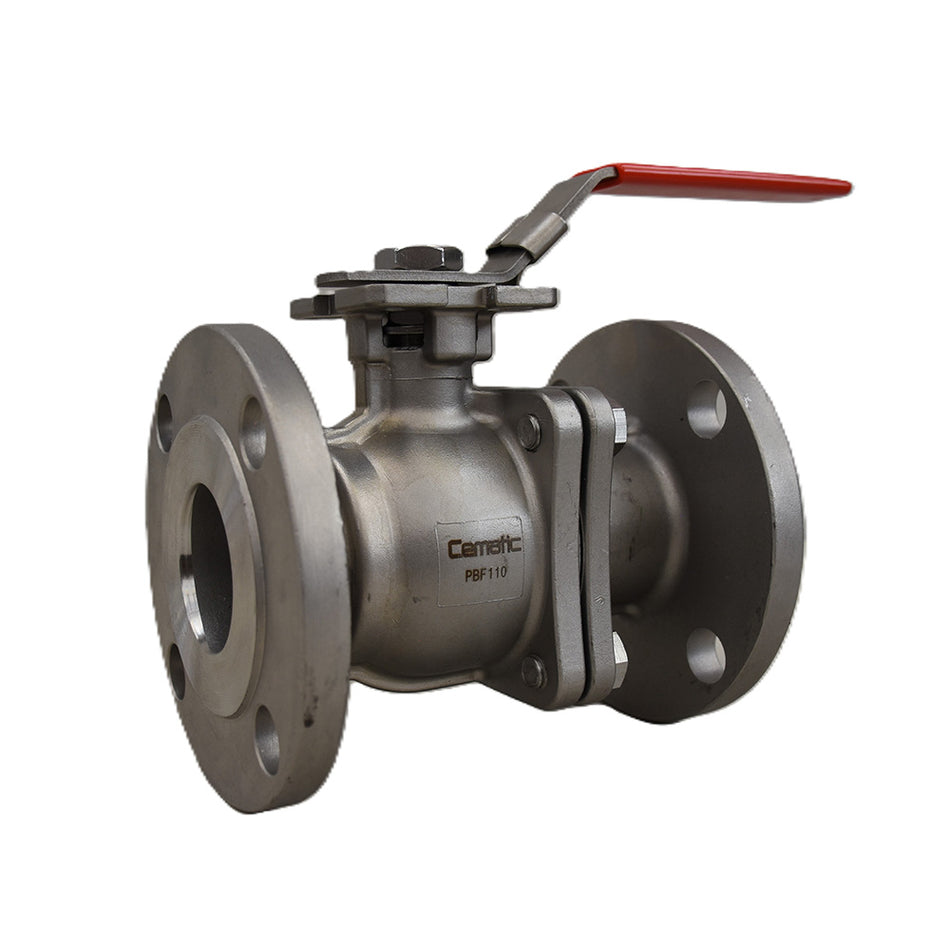
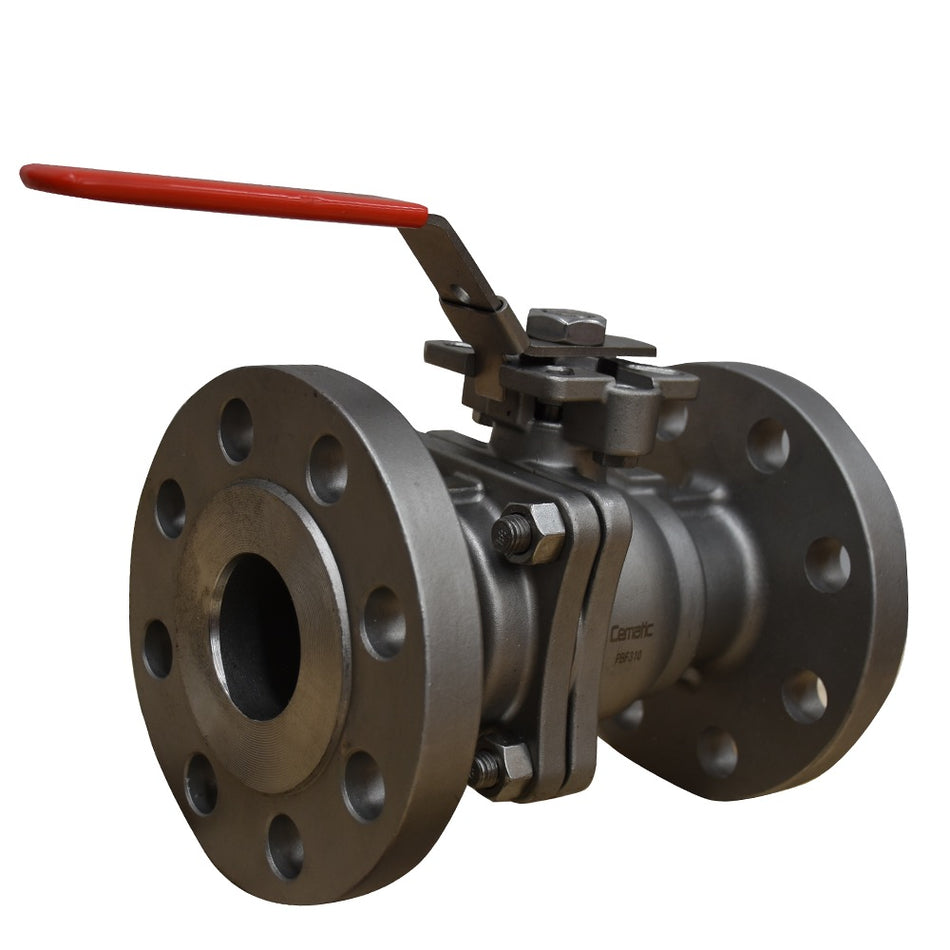
SS316 Ball Valve with ANSI 150 and 300 Flange — For Higher Pressure and Diameter
The ANSI 150 and ANSI 300 flanged connection is the process industry standard for ball valves in higher pressure, larger diameter lines, or where valve disassembly and replacement must be possible without cutting the pipe. The two flanges of the valve are bolted to the pipe flanges with bolts and gaskets—the valve can be completely disassembled by removing the bolts without affecting the pipe.
- ANSI 150: Up to 19.6 bar at room temperature—for most industrial process services at moderate pressures
- ANSI 300: Up to 50 bar at room temperature—for higher pressure services in chemical, oil and gas, and steam
- Diameters: DN25 (1") to DN200 (8")—in the most frequent diameters in Mexican industry
- Face-to-face: ASME B16.10—installation compatible with gate and globe valves of the same rating
👉 View full range: SS316 ANSI Flange Ball Valve →
SS316 Clamp Ball Valve — Hygiene and Quick Disassembly
The Tri-Clamp (ISO 2852) clamp connection is the standard joining system in the food, beverage, pharmaceutical, and biotechnology industries. The SS316 clamp ball valve combines the Class VI hermetic sealing of the ball with the quick disassembly in seconds without special tools allowed by the clamp system—essential for cleaning verifications, visual inspection of the interior, and compliance with Good Manufacturing Practices (GMP).
- Clamp diameters: DN25 (1") to DN100 (4") in the most demanded sizes
- Internal surface: Polished Ra ≤ 0.8 µm standard to meet 3-A and EHEDG hygienic design requirements
- Clamp gasket: FDA EPDM or FDA silicone included with the valve
👉 View full range: SS316 Clamp Ball Valve →
Materials — standard and alternatives
| Component | Standard material | Available alternatives | When to specify alternative |
|---|---|---|---|
| Body | SS316 (CF8M in flanges) | SS316L, SS304, Duplex 2205 | 316L for frequent welding; Duplex for high chloride concentration |
| Ball | Polished SS316 | Chrome-plated SS316, Hastelloy C | Chrome-plated for higher surface hardness; Hastelloy for extreme corrosion |
| Seats | Virgin PTFE | RTFE (reinforced PTFE), PEEK, Nylon | RTFE for higher mechanical resistance; PEEK for temperatures > 200°C |
| Stem packing | PTFE | Expanded graphite | Graphite for steam > 150°C or high temperature service |
| Handle | Stainless steel or aluminum | SS316, Nylon | SS316 for environments with corrosive vapors |
General technical specifications
- Type: Quarter-turn ball, full or reduced port
- Body: SS316 stainless steel (threaded), CF8M — cast SS316 equivalent (flanged)
- Ball: SS316 stainless steel with mirror polished finish
- Seats: Standard virgin PTFE
- Stem packing: PTFE or graphite depending on service temperature
- Tightness: Bidirectional Class VI (ANSI/FCI 70-2)
- Nominal diameters: DN15 (½") to DN200 (8") depending on configuration
- Nominal pressure: PN64 for threaded (up to 64 bar at room temperature); ANSI 150 or ANSI 300 for flanged
- Operating temperature: -20 °C to +180 °C with standard PTFE seat; up to -196 °C (cryogenic) with special version
- Design standards: API 608 (metal-seated ball valves for process), ASME B16.34 (pressure-temperature)
- Factory testing: API 598 — hydrostatic body test (1.5 × nominal pressure) and seat tightness test (nominal pressure)
- Actuator interface: ISO 5211 — compatible with quarter-turn pneumatic and electric actuators
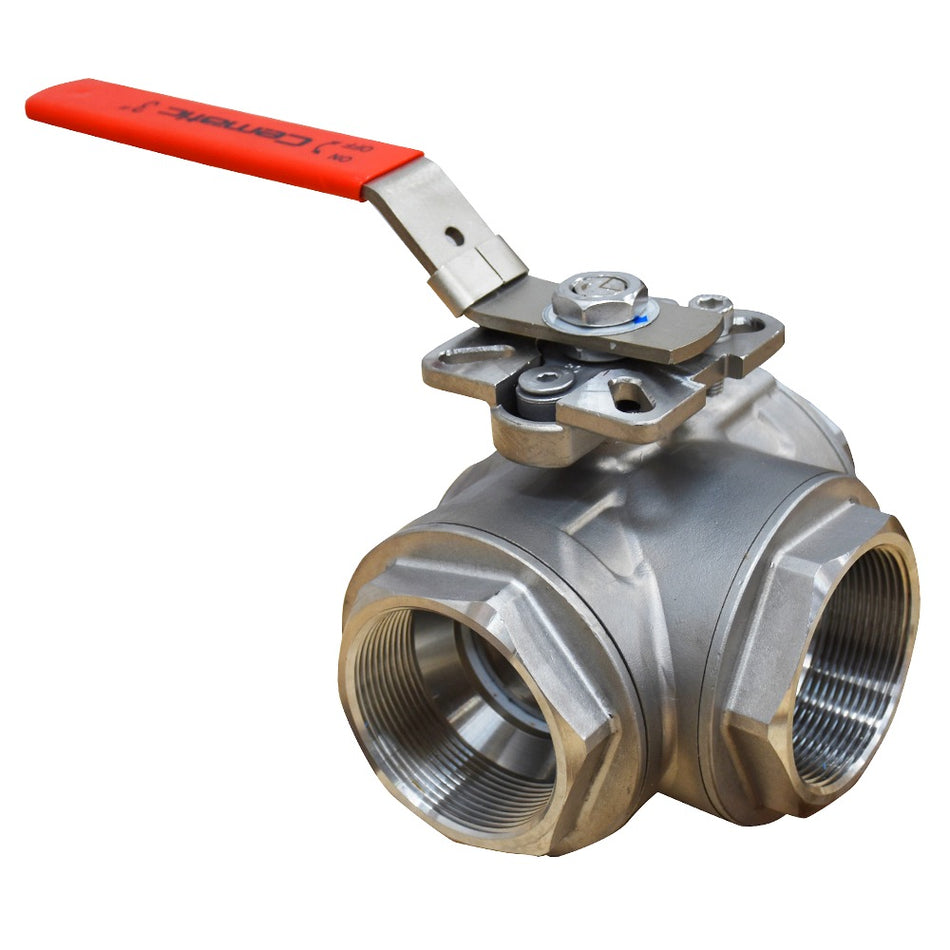
3-way SS316 ball valve
In addition to 2-way ball valves (one inlet and one outlet), Cematic supplies 3-way ball valves in SS316 with NPT threaded connections. The ball of a 3-way valve has an L- or T-shaped bore that allows two operating modes with a single valve:
- L-port configuration (2 positions): Connects one of the two side ports with the central port, alternating between two circuits by rotating 90°. Used for diverting flow between two destinations or for selecting one of two sources.
- T-port configuration (3 positions): In the middle position, simultaneously connects the two side ports with the central one. By rotating ±45°, it connects only one of the side ports. Used for mixing two flows or distributing to two destinations with an intermediate mixing position.
👉 View full range: 3-Way Ball Valves →
Automation of SS316 ball valves
The quarter-turn geometry of the ball valve makes it directly compatible with quarter-turn pneumatic and electric actuators via an ISO 5211 interface—the same interface as butterfly valves. For automation of SS316 ball valves:
- Single-acting NC/NO or double-acting pneumatic actuator: The most demanded option for ball valve automation in the chemical, food, and process industries. The operating torque of a ball valve is typically greater than that of a butterfly valve of the same diameter—verify the correct actuator torque with process pressure data. View ball valve assembly with pneumatic actuator →
- ON/OFF or modulating electric actuator: For installations without a compressed air network, 4–20 mA modulating control, or Modbus integration with SCADA. View ball valve assembly with electric actuator →
SS316 Ball Valve vs. SS316 Butterfly Valve — when to choose each
| Criterion | SS316 Ball Valve | SS316 Wafer Butterfly Valve |
|---|---|---|
| Tightness | ✅ Class VI — hermetic | Class III–IV — sufficient for general process |
| Full port | ✅ Full port available — no obstruction | Disc always in the flow path |
| Pressure drop when open | ✅ Minimal with full port | Greater — disc creates resistance |
| Line pigging | ✅ Compatible with full port | ❌ Not compatible |
| Cost in DN150–DN300 | Higher | ✅ Significantly lower |
| Weight and axial space | Higher in DN100+ | ✅ More compact and lighter |
| Main diameters | DN15–DN100 (threaded), up to DN200 (flanged) | ✅ DN50–DN1200 |
| Native modulating control | ⚠️ Only V-port ball valve | ⚠️ Only high performance with positioner |
| 3-way in a single valve | ✅ Available | ❌ Not available |
| Main application | DN15–DN80 threaded, instrumentation, process | DN80–DN1200 water, HVAC, large diameter process |
Main industries and applications
- Chemical and petrochemical industry: Isolation of process lines, sampling points, service valves in instrumentation, isolation of measuring instruments. The SS316 NPT threaded ball valve is the standard isolation device in instrumentation manifolds for process plants in Mexico.
- Oil & Gas — low and medium pressure services: Isolation of natural gas, LP gas, and process oil lines. SS316 NPT threaded ball valves up to DN50 and ANSI 150/300 flanged ball valves for larger diameters. PTFE's compatibility with hydrocarbons makes it the standard choice in these services.
- Seawater and coastal systems: Isolation in desalination plants, seawater cooling systems, port facilities. The molybdenum in SS316 resists seawater chlorides in continuous service without pitting—SS304 would fail in weeks in this service.
- Food and beverage industry: The SS316 clamp ball valve is the standard isolation component in dairy product, juice, fermented beverage, and purified water lines. The SS316 threaded ball valve in auxiliary services (process water, steam, CIP distribution). Both with FDA-approved PTFE for food contact.
- Pharmaceutical industry: Isolation of purified water (PW), water for injection (WFI), and clean steam lines. SS316 clamp or weldable ball valve for direct product contact; SS316 threaded ball valve for auxiliary services and process water distribution in non-critical areas.
- Compressed air and industrial gases: Isolation of instrumentation compressed air, nitrogen, CO₂, and oxygen lines. The Class VI tightness of the ball valve prevents gas leaks that would be inevitable in butterfly valves during frequent closing cycles.
- HVAC and process water: Service points, balancing valves, isolation of individual equipment (pumps, heat exchangers, filters) in cold and hot water circuits where SS316 offers greater durability than brass or iron without the cost of a special solution.
- Reverse osmosis water and purified water: The SS316 ball valve is the standard material for isolation in reverse osmosis systems—carbon steel would dissolve in contact with low-conductivity water, and SS316 is sufficiently inert not to contaminate purified water.
Why choose Cematic for your SS316 ball valves?
We have the widest stock of SS316 ball valves in Mexico City—NPT threaded from ½" to 3" in full port, ANSI 150 flanged in the most popular diameters, and clamped in the sizes most demanded by the food and pharmaceutical industries, all with immediate availability. We advise on selecting the correct connection type for each installation, on the full port vs. reduced port decision, and on choosing the seat material when standard PTFE is not sufficient. We supply with SS316 material certificates when the project requires it. Quotation on the same business day. Shipments throughout the Mexican Republic. Contact us via WhatsApp or at ventas@cematic.com.